EU REACH Adds Restrictions on Antiscalants for Industrial RO Membranes




On 29 May 2026, the European Union formally amended Annex XVII of the REACH Regulation to restrict three classes of organic antiscalants—including derivatives of diethylenetriamine pentaacetic acid (DTPA)—affecting industrial reverse osmosis (RO) membrane systems used in seawater desalination and chemical process cooling water circuits. This update signals immediate implications for exporters, chemical formulators, and system integrators supplying to the EU market.
Event Overview
On 29 May 2026, the European Commission published an official update to REACH Annex XVII, introducing new import restrictions on three categories of organic antiscalants, specifically including DTPA derivatives. The restriction enters into force on 1 November 2026. From that date, all suppliers placing industrial RO membrane components on the EU market must provide a complete SVHC declaration, a documented assessment of technically and economically feasible alternatives, and verifiable supply chain traceability data.
Industries Affected by the Restriction
Direct Exporters of Industrial RO Membrane Components
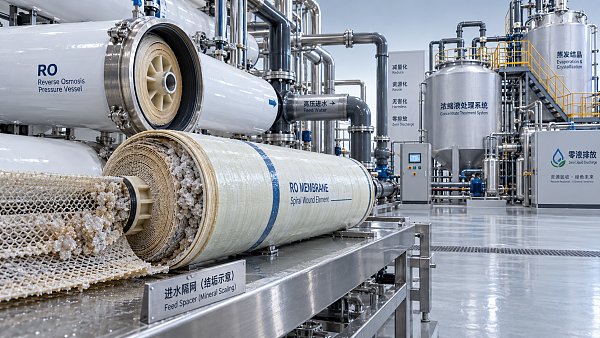
These companies are directly subject to the compliance obligation. As the regulation targets ‘RO membrane components’ placed on the EU market—not just standalone chemicals—their finished products (e.g., spiral-wound elements, housings with integrated pre-treatment modules) fall under scope if they contain or are intended for use with the restricted antiscalants. Impact manifests in mandatory documentation submission, potential redesign of pre-treatment integration, and increased customs clearance scrutiny.
Chemical Formulators & Antiscalant Producers
Manufacturers supplying antiscalants to RO system integrators or end users in the EU must verify whether their formulations contain any of the newly restricted substances—particularly DTPA-based chelating agents widely used in high-salinity feedwater conditioning. Non-compliant formulations may no longer be placed on the EU market after 1 November 2026, triggering reformulation timelines and testing requirements.
System Integrators & OEMs Using Pre-Treated Modules
Firms embedding antiscalant delivery mechanisms (e.g., dosing cartridges, controlled-release media) into RO skids or pre-filtration assemblies must assess whether those subcomponents rely on restricted chemistries. The requirement for supply chain traceability applies across tiers—meaning integrators must obtain and retain documentation from upstream chemical suppliers, even if they do not manufacture the antiscalants themselves.
What Relevant Companies or Practitioners Should Focus On — and How to Respond
Monitor Official Implementation Guidance from ECHA and National Competent Authorities
The restriction text is confirmed, but technical guidance on acceptable alternative assessment methodologies, SVHC declaration formats, and traceability data standards has not yet been published. Companies should track updates from the European Chemicals Agency (ECHA) and national REACH enforcement bodies ahead of the 1 November 2026 deadline.
Identify and Prioritize High-Risk Product Lines Based on Feedwater Application
Restrictions target antiscalants used in seawater desalination and industrial recirculating cooling systems—applications where DTPA derivatives are most prevalent due to their efficacy against multivalent cations. Companies should audit product portfolios to flag RO membranes or pre-treatment kits marketed explicitly for these segments, as they face higher regulatory exposure.
Distinguish Between Regulatory Signal and Operational Readiness
This amendment reflects a policy decision already adopted—not a proposal under consultation. However, enforcement timelines, audit frequency, and accepted evidence for ‘feasible alternatives’ remain subject to interpretation. Firms should treat the 29 May 2026 publication as the definitive trigger for internal compliance planning—not as a preliminary warning.
Initiate Supplier Engagement and Documentation Collection Now
Supply chain traceability requires documented evidence from each tier. Exporters should request updated declarations and alternative assessments from antiscalant suppliers immediately—even if shipments occur before November 2026—to avoid delays in post-implementation audits or customs holds.
Editorial Perspective / Industry Observation
Observably, this amendment marks a shift toward regulating functional chemical performance within assembled equipment—not only as standalone substances. It treats antiscalant chemistry as an intrinsic part of RO membrane system compliance, rather than a separable consumable. Analysis shows this approach increases accountability across the value chain, especially for OEMs who previously treated chemical selection as a downstream customer choice. From an industry perspective, it is better understood as a binding regulatory outcome—not a signal or draft measure—given its formal adoption and fixed enforcement date. Continued attention is warranted because enforcement practices, particularly regarding ‘technically and economically feasible alternatives’, are likely to evolve through case-by-case evaluation in the first 12–18 months post-implementation.
This update underscores that REACH compliance for water treatment equipment is no longer limited to substance registration or SVHC communication alone—it now extends to performance-related chemistry embedded in engineered systems. For affected stakeholders, the current priority is not speculation about future amendments, but verification of existing product configurations against the newly listed substances and preparation of required documentation well ahead of the 1 November 2026 deadline.
Source: European Commission Regulation amending Annex XVII to Regulation (EC) No 1907/2006 (REACH), published 29 May 2026. Note: Technical guidance documents from ECHA and national authorities remain pending and are subject to ongoing monitoring.
Related News
 When does self-cleaning filtration technology reduce maintenance downtime?Separation Tech FellowFiltration technology can reduce maintenance downtime when solids are predictable, cleaning is automated, and reject handling is reliable. Learn how to select the right system.
 How fluid control digitalization improves valve maintenance planningProcess Control ArchitectFluid control digitalization helps teams prioritize valve maintenance, reduce unplanned downtime, and improve reliability with actionable condition data.
 What drives industrial wastewater treatment cost per cubic meter?Dr. Alistair VaughnIndustrial wastewater treatment cost per cubic meter depends on influent load, effluent targets, energy, technology, and sludge disposal. Explore the key cost drivers.
 How to verify CE compliance for fluid separation equipmentDr. Alistair VaughnFluid separation equipment CE verification made practical: learn how to check declarations, risk assessments, technical files, pressure safety, and installation readiness.
 How smart valve positioners improve process control valve accuracyProcess Control ArchitectDiscover how smart positioners improve process control valve accuracy, reduce friction-related errors, enhance stability, and enable predictive maintenance.
 Motor energy efficiency comparison for variable-speed compressor selectionPneumatic Power StrategistMotor energy efficiency comparison for variable-speed compressor selection: compare package power, load profiles, controls, and lifecycle savings.
 How fluid dynamics analysis helps size a chemical process pumpFluid Dynamics ScientistFluid dynamics analysis helps engineers size chemical process pumps for reliable flow, NPSH margin, efficiency, and safer long-term operation.
 Separation equipment trends reshaping industrial wastewater treatmentDr. Alistair VaughnSeparation equipment trends are reshaping industrial wastewater treatment through smarter membranes, modular systems, digital monitoring, and resource recovery strategies.
 Which valve technology standards apply to pneumatic diaphragm valves?Process Control ArchitectValve technology standards for pneumatic diaphragm valves: explore design, testing, actuator safety, hygienic compliance, and specification guidance for reliable selection.
 When stainless steel separation equipment is the right choice for hygienic processesDr. Alistair VaughnStainless steel separation equipment: discover when hygienic design, corrosion resistance, CIP cleanability, and lifecycle reliability make it the smart choice.
 When ZLD fouling in RO membranes requires more than cleaningSeparation Tech FellowZLD fouling in RO membranes: learn when CIP is no longer enough, how to identify irreversible damage, and which process changes protect recovery and reduce replacement costs.
 What to verify before choosing a self cleaning filtration systems supplierSeparation Tech FellowChoose a self cleaning filtration systems supplier with confidence. Verify flow capacity, cleaning performance, materials, automation, support, and lifecycle value.