Choosing an Industrial Wastewater Treatment Manufacturer




Choosing the right industrial wastewater treatment manufacturer is a strategic procurement decision that directly affects compliance, operating costs, and long-term plant reliability. As industries move toward stricter discharge standards, Zero Liquid Discharge targets, and energy-efficient fluid systems, buyers must look beyond equipment price and evaluate process expertise, separation technology, automation capability, and lifecycle support. This guide helps procurement teams identify manufacturers that can deliver stable treatment performance, scalable system design, and measurable value for demanding industrial applications.
Why Manufacturer Selection Matters in Industrial Wastewater Projects
An industrial wastewater treatment manufacturer is not simply an equipment vendor. In most process plants, the manufacturer influences discharge stability, pump reliability, membrane life, automation accuracy, sludge handling cost, and future expansion capacity.
For procurement teams, the lowest equipment quote can become expensive within 12–24 months if the system suffers from fouling, undersized pumps, poor chemical dosing, or weak after-sales support.
The procurement risk is both technical and financial
Industrial wastewater often contains variable COD, suspended solids, oil, salinity, heavy metals, acids, alkalis, solvents, or high-temperature streams. A stable design must handle fluctuations, not just average laboratory values.
A typical procurement review should cover at least 6 dimensions: influent characteristics, process route, hydraulic capacity, energy consumption, automation, and lifecycle service responsibility.
Common buyer priorities
- Meeting discharge limits under daily flow changes of 20%–50%.
- Reducing membrane replacement, chemical dosing, and sludge disposal costs.
- Ensuring pumps, valves, compressors, and separation modules operate as one coordinated system.
- Securing spare parts, remote diagnostics, and site response within agreed service windows.
This is where a fluid-system perspective becomes critical. Wastewater treatment is connected to centrifugal pump sizing, high-pressure pump selection, control valve precision, compressed air supply, filtration, RO membranes, and evaporation units.
Define Your Wastewater Profile Before Requesting Quotes
Before contacting an industrial wastewater treatment manufacturer, buyers should prepare a technical baseline. A vague request such as “quote a 500 m³/day system” is usually insufficient.
A manufacturer can only propose a reliable treatment process when it understands influent composition, daily flow peaks, operating shifts, discharge target, and available plant utilities.
Key information to collect
Procurement teams should request the environmental, production, maintenance, and utility departments to provide at least 3–6 months of operating data where available.
If the project is a new plant, use pilot testing, comparable process data, and conservative peak-load assumptions to avoid under-designed equalization and pretreatment units.
The table below summarizes practical data points that help manufacturers produce more accurate technical and commercial proposals.
The stronger the input data, the easier it becomes to compare manufacturers fairly. Without this baseline, quotes may differ by 30% or more because suppliers are designing around different assumptions.
Match technology to application
A chemical plant may need neutralization, oxidation, advanced filtration, and corrosion-resistant pumps. A food processing facility may require dissolved air flotation, biological treatment, and odor control.
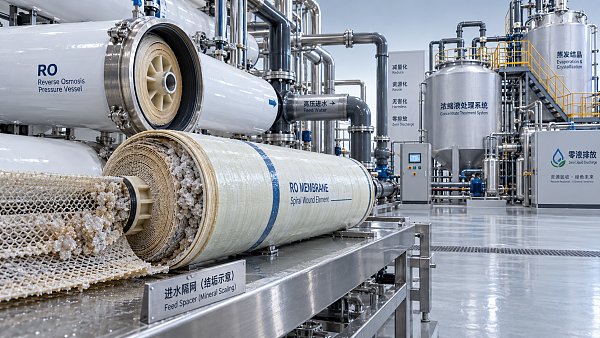
Electronics, battery, textile, mining, pharmaceutical, and metal finishing plants often demand different combinations of ion exchange, ultrafiltration, RO, evaporation, crystallization, or sludge dewatering.
Evaluate Process Capability, Not Just Equipment Price
A competent industrial wastewater treatment manufacturer should explain why a process route is selected, how each stage reduces pollutants, and which operating risks require monitoring.
For a 300–1,000 m³/day facility, small efficiency differences in pump power, aeration design, chemical dosing, and membrane recovery can meaningfully affect annual operating expenditure.
Process design depth
Ask whether the manufacturer performs water balance, mass balance, hydraulic calculation, chemical consumption estimation, sludge yield estimation, and energy load analysis before finalizing the proposal.
For ZLD-oriented projects, buyers should also examine concentration ratios, scaling control, heat integration, condensate quality, and salt handling methods across at least 3 operating scenarios.
Technical questions worth asking
- What influent fluctuation range is included in the design safety factor?
- Which pretreatment steps protect RO membranes, evaporators, pumps, and control valves?
- How is chemical dosing adjusted when pH, COD, or TSS changes by 20%?
- What online instruments are recommended for pH, ORP, turbidity, conductivity, and flow?
Core equipment integration
Industrial treatment reliability depends on integrated fluid control. Pump curves must match system head, valves must avoid unstable throttling, and compressors must support aeration demand efficiently.
A manufacturer familiar with industrial centrifugal pumps, plunger pumps, pneumatic control valves, air compressor systems, and filtration modules can reduce interface disputes during commissioning.
The following comparison helps procurement teams separate basic equipment supply from integrated system manufacturing capability.
A stronger manufacturer reduces procurement uncertainty by making engineering assumptions visible. This is especially valuable when tenders include performance guarantees, penalties, or phased capacity expansion.
Check Automation, Energy Efficiency, and Digital Maintenance
Modern wastewater systems are increasingly judged by stable operation and energy performance, not only by whether effluent passes one acceptance test on commissioning day.
A capable industrial wastewater treatment manufacturer should design control loops that reduce manual intervention, improve repeatability, and provide early warnings before equipment failure.
Automation functions to include
For medium and large industrial sites, PLC-based control with data logging is often essential. At minimum, buyers should require flow, level, pressure, pH, conductivity, and key pump status monitoring.
For membrane and ZLD systems, additional monitoring may include differential pressure, permeate conductivity, recovery rate, evaporator temperature, anti-scalant dosing, and cleaning-in-place cycles.
- Alarm hierarchy with at least 3 levels: warning, shutdown, and emergency stop.
- Trend records for 30–180 days to support troubleshooting and compliance reporting.
- Remote diagnostic interface for authorized service teams and plant engineers.
- Automatic cleaning, backwash, or blowdown sequences to reduce operator dependency.
Energy and carbon considerations
Energy consumption is often concentrated in pumps, blowers, compressors, mixers, and thermal concentration units. A 5%–15% efficiency improvement can matter over a 10-year lifecycle.
Procurement teams should request estimated kWh per cubic meter, pump motor efficiency class, variable frequency drive strategy, aeration control method, and expected chemical consumption range.
Where digital maintenance adds value
Predictive maintenance is practical when critical equipment has vibration, temperature, pressure, and runtime data. Pumps and compressors benefit from early detection of bearing wear or fouling.
Control valves also deserve attention. Poor valve sizing can create noise, unstable throttling, erosion, or poor dosing accuracy, which may disrupt downstream separation performance.
Review Compliance, Materials, and Build Quality
Industrial wastewater treatment involves corrosive fluids, abrasive solids, variable temperatures, and sometimes hazardous chemicals. Material selection directly affects safety and replacement frequency.
The right industrial wastewater treatment manufacturer should clearly specify wetted materials, coating systems, gasket compatibility, corrosion allowance, and maintenance access around each process unit.
Material and fabrication review
Common material choices include carbon steel with lining, stainless steel grades, FRP, HDPE, PP, PVDF, and rubber-lined components. Selection depends on pH, chloride, temperature, and chemical exposure.
Buyers should request welding inspection records, coating thickness checks, pressure testing, electrical cabinet standards, and factory acceptance test procedures before shipment.
Practical inspection checkpoints
- Verify tank dimensions, nozzle orientation, and pipe connection sizes against approved drawings.
- Confirm pump, valve, instrument, membrane, and electrical component nameplates before delivery.
- Check coating, lining, and insulation quality at nozzles, edges, welds, and supports.
- Require dry testing or water testing for packaged systems where practical.
Regulatory and documentation expectations
Documentation should be treated as part of the deliverable. Missing drawings, operating manuals, instrument lists, and maintenance schedules can delay commissioning by 2–6 weeks.
A complete package commonly includes PFD, P&ID, equipment layout, electrical diagrams, I/O list, spare parts list, chemical handling guidance, and commissioning protocol.
Compare Commercial Terms and Lifecycle Cost
Procurement teams should compare manufacturers using total cost of ownership, not only purchase price. Two systems with similar capacity may differ greatly in power, chemicals, maintenance, and downtime.
A transparent industrial wastewater treatment manufacturer will help buyers understand CAPEX, OPEX, consumables, labor demand, replacement intervals, and service costs over 5–10 years.
Commercial items to normalize
When bids are received, align the scope line by line. Exclusions such as civil works, chemical tanks, cable trays, instruments, foundations, or installation supervision can distort comparison.
Also confirm whether the quoted price includes design review, factory testing, export packing, commissioning, operator training, and performance testing after stable operation.
- Set a technical clarification round lasting 7–15 days for medium-complexity projects.
- Request a revised commercial offer after all suppliers answer the same question list.
- Score bids using weighted criteria, such as 40% technical, 30% lifecycle cost, 20% delivery, and 10% service.
- Reserve a final negotiation stage for guarantees, spare parts, and commissioning responsibilities.
Lead time and project execution
Typical packaged wastewater systems may require 8–20 weeks for engineering, manufacturing, inspection, and delivery. Large ZLD or multi-stage process systems can take longer.
The delivery plan should include drawing approval, long-lead procurement, fabrication, assembly, testing, shipment, installation, cold commissioning, hot commissioning, and performance verification.
Questions Procurement Teams Should Ask Before Award
Final selection should not depend on presentation quality alone. Buyers need evidence that the manufacturer can deliver stable treatment performance under real industrial operating conditions.
A structured pre-award review reduces ambiguity and helps both sides agree on what will be measured, delivered, tested, and supported after startup.
Pre-award checklist
- Can the manufacturer explain at least 3 alternative process routes and why they were rejected?
- Are guarantees linked to defined influent ranges, flow rates, and operating conditions?
- Does the offer include recommended spare parts for the first 12–24 months?
- Is there a clear training plan for operators, maintenance staff, and electrical engineers?
- Are service response times, remote support methods, and site visit conditions stated in writing?
Common mistakes to avoid
One common mistake is buying a system designed only for average flow. Equalization, peak load, cleaning cycles, and emergency storage must be evaluated together.
Another mistake is separating wastewater equipment from plant utilities. Compressed air pressure, power quality, steam availability, chemical logistics, and drainage routes all affect performance.
How FCSM intelligence supports better decisions
FCSM observes the machinery systems behind industrial water treatment: pumps, high-pressure equipment, smart valves, compressors, filtration, membranes, and separation technologies.
For buyers, this integrated view is useful because wastewater treatment performance is created by the entire fluid control network, not by one tank or one membrane module.
Make the Final Choice with a System-Level Mindset
Choosing an industrial wastewater treatment manufacturer requires balancing compliance, engineering depth, automation, delivery reliability, and long-term operating cost.
The best procurement outcome comes from a manufacturer that understands wastewater chemistry, separation technology, fluid machinery, digital control, and lifecycle service in one coherent package.
Before awarding a contract, define the influent envelope, confirm the process route, review equipment integration, normalize commercial scope, and secure measurable acceptance criteria.
If your team is evaluating suppliers for a new treatment plant, retrofit, ZLD upgrade, or energy-efficiency improvement, use a structured technical comparison rather than price alone.
To explore more fluid control, pump, valve, compressor, and separation machinery insights for industrial wastewater projects, contact us now, request a tailored solution, or consult detailed product and system guidance.
Related News
 When ZLD fouling in RO membranes requires more than cleaningSeparation Tech FellowZLD fouling in RO membranes: learn when CIP is no longer enough, how to identify irreversible damage, and which process changes protect recovery and reduce replacement costs.
 What Are the Risks of Skipping Pretreatment Before Zero Liquid Discharge?Separation Tech FellowWhat are the risks of skipping pretreatment before zero liquid discharge? Discover how poor feed conditioning drives fouling, scaling, corrosion, energy waste, and costly ZLD downtime.
 What drives reverse osmosis system price for industrial projects?Separation Tech FellowReverse osmosis system price explained: compare industrial RO costs, feedwater risks, energy use, recovery, and lifecycle value for smarter purchasing decisions.
 How to Evaluate a Membrane Separation Technology Supplier for Process Fit and Lifecycle CostSeparation Tech FellowMembrane separation technology supplier selection starts with process fit. Learn how to compare lifecycle cost, fouling control, engineering quality, and service support.
 US Rule Sets New Entry Tests for Industrial RO MembranesSeparation Tech FellowIndustrial RO membranes face new U.S. entry tests from Oct 1, 2026. Learn how DOE rules, PFAS bans, and certification checks may impact imports, compliance, and market access.
 EU Tightens CE Checks for RO MembranesSeparation Tech FellowEU Tightens CE Checks for RO Membranes: learn how new EU surveillance rules, third-party verification, and traceability demands may delay imports and reshape compliance for suppliers.
 EU REACH Update Adds Nano Disclosure for RO MembranesSeparation Tech FellowEU REACH Update Adds Nano Disclosure for RO Membranes: learn how new nanoform registration and SDS-Nano rules impact EU market access, customs clearance, and CE compliance.
 Revised EN 16798-4 Raises RO Energy ComplianceSeparation Tech FellowRevised EN 16798-4 raises EU energy compliance for Industrial RO Membranes, SWRO high-pressure pumps, and desalination systems. Learn key deadlines, DEP rules, and CE/UKCA cost impacts.
 FDA Adds 72-Hour Pre-Arrival Filing for RO MembranesSeparation Tech FellowFDA adds a 72-hour pre-arrival filing for industrial RO membranes and filtration components. Learn key compliance impacts, ACE filing needs, and how importers can avoid delays.
 EN 16754:2026 Adds Dual Certification for Industrial RO MembranesSeparation Tech FellowIndustrial RO membranes face a major EU compliance shift under EN 16754:2026. Learn how dual certification impacts exports, customs clearance, and supplier readiness before October 2026.
 FDA Import Alert Tightens RO Membrane Entry RulesSeparation Tech FellowFDA import alert update tightens RO membrane entry rules from Oct 1, 2026. Learn how chlorine resistance testing, ISO/IEC 17025 reports, and shipment compliance may impact exporters and importers.
 EU EN 14987:2026 Takes Effect for Industrial RO Membrane ExportsSeparation Tech FellowEU EN 14987:2026 now affects industrial RO membrane exports to Europe. Learn the new test requirements, customs risks, and buyer compliance steps to protect market access.