How ZLD Technology Cuts Membrane Fouling




For technical evaluators, the core question is not whether membrane fouling can be reduced, but whether a ZLD design can control fouling predictably enough to protect uptime, energy efficiency, and compliance. In practice, the best zero liquid discharge systems technology does not rely on a single membrane upgrade. It cuts fouling through integrated pretreatment, stable hydraulics, fit-for-duty membrane selection, disciplined cleaning strategy, and continuous data-based optimization.
That matters because membrane fouling is rarely just a maintenance issue. In ZLD applications, it directly affects flux stability, chemical consumption, evaporator loading, brine concentration strategy, and total cost of ownership. For teams evaluating suppliers or process configurations, the right assessment focus is whether the system can maintain separation performance under changing feed conditions without excessive intervention.
This article explains how advanced ZLD systems reduce fouling, what design choices make the biggest difference, and which technical signals evaluators should use when comparing solutions. The goal is to help readers judge long-term reliability rather than short-term nameplate performance.
What technical evaluators are really trying to verify in ZLD membrane design
When users search for how ZLD technology cuts membrane fouling, they are usually assessing risk. They want to know whether a proposed system can handle difficult wastewater while keeping membrane cleaning, replacement, and energy escalation under control.
For technical evaluators, the most important concerns are practical. How fast will differential pressure rise? How stable will normalized flux remain? How sensitive is the system to solids, organics, silica, hardness, oil, or biological load?
They also want evidence that the membrane train works as part of the full ZLD process. A membrane skid that performs well in isolation may still fail economically if upstream pretreatment is weak or if downstream thermal concentration creates unstable recycle conditions.
That is why the strongest evaluation framework combines process compatibility, operational resilience, cleanability, automation quality, and lifecycle economics. In zero liquid discharge systems technology, fouling control should be seen as a system-level capability, not a membrane-only feature.
Why membrane fouling becomes so severe in ZLD applications
ZLD systems operate close to the limits of concentration. As water is progressively removed, dissolved salts, colloids, sparingly soluble minerals, and organic matter all move closer to precipitation or deposition thresholds.
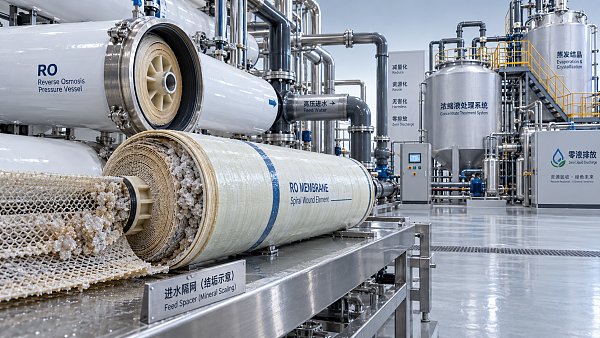
In reverse osmosis and related membrane stages, fouling usually appears in several forms. These include inorganic scaling, particulate or colloidal plugging, organic adsorption, and biofouling. In many industrial wastewaters, these mechanisms overlap rather than occur separately.
High recovery targets make the situation harder. As concentration polarization intensifies near the membrane surface, local solute levels can become much higher than bulk levels, accelerating deposition even when average feed chemistry appears acceptable.
Feed variability is another major driver. Industrial wastewater rarely behaves like a fixed laboratory stream. Shifts in pH, suspended solids, surfactants, solvents, or upstream production campaigns can rapidly change fouling behavior and destabilize membrane operation.
This is why technical evaluators should be cautious when vendors present only average feed values. Fouling risk is shaped by transient events, upset tolerance, and control response, not just by normal operating chemistry.
Smarter pretreatment is the first and biggest fouling control lever
If evaluators want to identify the most effective fouling reduction strategy, pretreatment should be their first focus. In many ZLD systems, membrane reliability is determined more by pretreatment quality than by membrane brand or nominal flux.
Good pretreatment removes or neutralizes the foulants most likely to accumulate downstream. Depending on the wastewater, that may mean clarification, dissolved air flotation, multimedia filtration, ultrafiltration, activated carbon, softening, pH adjustment, oxidation, or selective chemical precipitation.
For high-silica, high-hardness, or metal-rich streams, targeted chemistry control is especially important. Scaling ions must often be reduced before they reach the membrane array, because antiscalants alone may not provide enough protection at aggressive recoveries.
Oil and grease also deserve close attention. Even small carryover can create persistent hydrophobic fouling, reduce membrane wetting behavior, and interfere with cleaning effectiveness. Systems treating refinery, food, metalworking, or chemical wastewater should show robust oil removal upstream.
Technical evaluators should ask for pretreatment design logic tied to actual foulant categories, not generic statements about filtration. The best zero liquid discharge systems technology maps each likely foulant to a specific control step and defines what happens when feed quality drifts.
Hydraulic design and flow control strongly influence fouling rates
Membrane fouling is also shaped by fluid mechanics. Even with good pretreatment, poor hydraulic design can create stagnant zones, uneven crossflow, excessive concentration polarization, and early channel blockage.
Well-engineered systems maintain the right balance between flux and crossflow velocity. Running too aggressively may improve short-term recovery but often drives faster deposition, higher pressure drop, and more frequent chemical cleaning.
Stable pressure control matters as much as nominal design values. Pump fluctuation, valve hunting, and uneven staging can expose membranes to repeated stress and unstable local conditions, increasing fouling and reducing membrane life.
This is where expertise in fluid control equipment becomes relevant. High-efficiency pumps, precise control valves, and responsive instrumentation help keep membrane trains within tight operating windows. In practice, good flow control is a fouling mitigation tool.
Evaluators should look for evidence of sound staging, proper recirculation design, accurate pressure monitoring, and control logic that prevents over-fluxing during startup, shutdown, and feed transients. These details often distinguish durable systems from fragile ones.
Membrane selection should match foulant profile, not just rejection targets
Many buyers focus heavily on salt rejection and recovery potential. Those metrics matter, but fouling resistance and cleanability are often more important for long-term ZLD economics.
Different membrane materials and surface properties respond differently to organics, oxidants, pH extremes, and cleaning chemicals. A membrane with excellent rejection may still perform poorly if its surface chemistry attracts the dominant foulants in a given wastewater.
Element configuration also matters. Feed spacer geometry, channel height, and module arrangement affect solids tolerance and pressure drop behavior. For difficult industrial streams, a design with slightly lower nominal productivity may deliver better lifecycle performance if it resists plugging.
Technical evaluators should therefore ask how the selected membrane was matched to the feed matrix. Was the choice based on pilot data, fouling history from comparable plants, or only on catalogue specifications?
In advanced zero liquid discharge systems technology, membrane selection is usually tied to pretreatment effectiveness, cleaning strategy, and target operating envelope. The right answer is rarely the highest-flux membrane on paper.
Data-driven monitoring helps systems prevent fouling instead of reacting late
One of the clearest signs of a mature ZLD solution is its ability to detect fouling early. Operators should not have to wait for severe flux loss or a major pressure increase before taking action.
Strong monitoring programs track normalized permeate flow, differential pressure, salt passage, recovery rate, temperature correction, and cleaning intervals. Trending these values reveals whether fouling is scaling, organic, particulate, or operational in origin.
Modern automation can go further by correlating membrane behavior with upstream chemistry, tank levels, pump conditions, and dosing performance. This allows operators to catch root causes such as pretreatment breakthrough, antiscalant underdosing, or unstable pH control.
For technical evaluators, digital capability should be reviewed as a functional reliability feature, not an optional software add-on. Data visibility shortens troubleshooting time and supports more confident operation near design limits.
When comparing vendors, ask whether the control platform provides actionable diagnostics or only raw signals. The most valuable systems turn operating data into decisions that reduce fouling progression and avoid unnecessary cleaning.
Cleaning strategy and recoverability are part of fouling control
Even well-designed systems foul over time. The real question is whether fouling can be reversed efficiently before it becomes permanent. That makes cleaning strategy a critical evaluation category.
A strong design includes defined clean-in-place triggers, chemical protocols matched to likely foulants, and hardware that supports effective flow distribution during cleaning. If cleaning is poorly designed, residual deposits can accumulate from cycle to cycle.
Evaluators should look beyond the statement that a system is CIP-capable. They should ask how often cleaning is expected, what chemicals are required, how membrane performance recovers after cleaning, and what level of irreversible fouling has been observed.
Membrane recoverability affects both operating cost and asset life. A system that needs frequent but effective cleaning may still outperform one that seems stable at first but suffers rapid permanent decline later.
In ZLD, cleaning decisions also influence the wider plant. More frequent membrane cleaning changes chemical handling, wastewater management, and downstream load balance. Therefore, fouling control should be evaluated in terms of whole-plant operability.
How to evaluate whether a ZLD supplier can truly control fouling
For technical evaluators reviewing proposals, the best questions are concrete. Ask for feedwater envelopes, not single-point values. Ask what foulants were assumed, how pretreatment was sized, and which failure modes the controls are designed to handle.
Request pilot results or references from wastewater streams with similar chemistry and variability. Similarity should include not only TDS, but also silica, hardness, COD, oil, surfactants, metals, suspended solids, and temperature range.
Ask vendors to show projected normalized flux decline, pressure drop progression, cleaning frequency, and membrane replacement assumptions over time. These indicators are more useful than idealized peak recovery numbers.
It is also worth reviewing component integration. Reliable pumps, precise valves, stable dosing systems, and well-placed sensors are all part of membrane fouling control. Mechanical and control quality directly affect separation performance.
Finally, examine how the membrane stage interacts with evaporators, crystallizers, and brine management strategy. The best zero liquid discharge systems technology minimizes fouling while optimizing the total ZLD train, not just one unit operation.
The bigger value: lower fouling means better economics, compliance, and confidence
Reducing membrane fouling creates benefits far beyond membrane maintenance. It lowers specific energy consumption, reduces unplanned downtime, cuts chemical use, and helps stabilize water recovery across varying feed conditions.
For organizations facing strict discharge rules or water reuse targets, lower fouling also supports compliance confidence. A stable membrane section protects the downstream thermal process from shock loading and improves overall plant predictability.
From a capital planning perspective, effective fouling control reduces the risk that actual operating cost will diverge from proposal-stage assumptions. That is especially important in ZLD, where small membrane underperformance can cascade into major total cost penalties.
In short, membrane fouling control is a proxy for engineering maturity. Systems that handle fouling well are usually stronger in pretreatment, hydraulics, automation, and lifecycle design overall.
For technical evaluators, that makes fouling analysis one of the most useful ways to separate robust ZLD solutions from optimistic ones.
Conclusion
How ZLD technology cuts membrane fouling is ultimately a question of integrated engineering. The most reliable systems combine fit-for-purpose pretreatment, disciplined hydraulic control, appropriate membrane selection, early-warning monitoring, and practical cleaning design.
For technical evaluators, the key is to assess whether those elements work together under real industrial variability. If they do, zero liquid discharge systems technology can deliver not only lower fouling, but also stronger uptime, lower lifecycle cost, and more dependable compliance performance.
Rather than asking which membrane is best in isolation, ask which complete system best controls the conditions that cause fouling. That shift in evaluation logic usually leads to better long-term decisions.
Related News
 When ZLD fouling in RO membranes requires more than cleaningSeparation Tech FellowZLD fouling in RO membranes: learn when CIP is no longer enough, how to identify irreversible damage, and which process changes protect recovery and reduce replacement costs.
 What Are the Risks of Skipping Pretreatment Before Zero Liquid Discharge?Separation Tech FellowWhat are the risks of skipping pretreatment before zero liquid discharge? Discover how poor feed conditioning drives fouling, scaling, corrosion, energy waste, and costly ZLD downtime.
 What drives reverse osmosis system price for industrial projects?Separation Tech FellowReverse osmosis system price explained: compare industrial RO costs, feedwater risks, energy use, recovery, and lifecycle value for smarter purchasing decisions.
 How to Evaluate a Membrane Separation Technology Supplier for Process Fit and Lifecycle CostSeparation Tech FellowMembrane separation technology supplier selection starts with process fit. Learn how to compare lifecycle cost, fouling control, engineering quality, and service support.
 US Rule Sets New Entry Tests for Industrial RO MembranesSeparation Tech FellowIndustrial RO membranes face new U.S. entry tests from Oct 1, 2026. Learn how DOE rules, PFAS bans, and certification checks may impact imports, compliance, and market access.
 EU Tightens CE Checks for RO MembranesSeparation Tech FellowEU Tightens CE Checks for RO Membranes: learn how new EU surveillance rules, third-party verification, and traceability demands may delay imports and reshape compliance for suppliers.
 EU REACH Update Adds Nano Disclosure for RO MembranesSeparation Tech FellowEU REACH Update Adds Nano Disclosure for RO Membranes: learn how new nanoform registration and SDS-Nano rules impact EU market access, customs clearance, and CE compliance.
 Revised EN 16798-4 Raises RO Energy ComplianceSeparation Tech FellowRevised EN 16798-4 raises EU energy compliance for Industrial RO Membranes, SWRO high-pressure pumps, and desalination systems. Learn key deadlines, DEP rules, and CE/UKCA cost impacts.
 FDA Adds 72-Hour Pre-Arrival Filing for RO MembranesSeparation Tech FellowFDA adds a 72-hour pre-arrival filing for industrial RO membranes and filtration components. Learn key compliance impacts, ACE filing needs, and how importers can avoid delays.
 EN 16754:2026 Adds Dual Certification for Industrial RO MembranesSeparation Tech FellowIndustrial RO membranes face a major EU compliance shift under EN 16754:2026. Learn how dual certification impacts exports, customs clearance, and supplier readiness before October 2026.
 FDA Import Alert Tightens RO Membrane Entry RulesSeparation Tech FellowFDA import alert update tightens RO membrane entry rules from Oct 1, 2026. Learn how chlorine resistance testing, ISO/IEC 17025 reports, and shipment compliance may impact exporters and importers.
 EU EN 14987:2026 Takes Effect for Industrial RO Membrane ExportsSeparation Tech FellowEU EN 14987:2026 now affects industrial RO membrane exports to Europe. Learn the new test requirements, customs risks, and buyer compliance steps to protect market access.