India Weighs Longer Petrochemical Duty Relief




The timing of this development is not clearly stated in the source material, but the policy direction is already drawing attention across export-oriented industrial supply chains. India is considering extending an import duty exemption covering 40 petrochemical products beyond June 30, 2026, in a move linked to support for its domestic plastics and pharmaceutical industries. For suppliers of chemical process pumps, industrial RO membranes, magnetic drive pumps, and related packaged solutions, the issue is not only tariff policy itself, but also how a longer period of tariff stability could influence procurement visibility, bidding activity, project timing, and delivery planning.
A tariff signal with direct downstream relevance
According to the provided information, India is considering extending the import duty exemption for 40 petrochemical products beyond June 30, 2026. The stated policy purpose is to support the local plastics and pharmaceutical sectors.
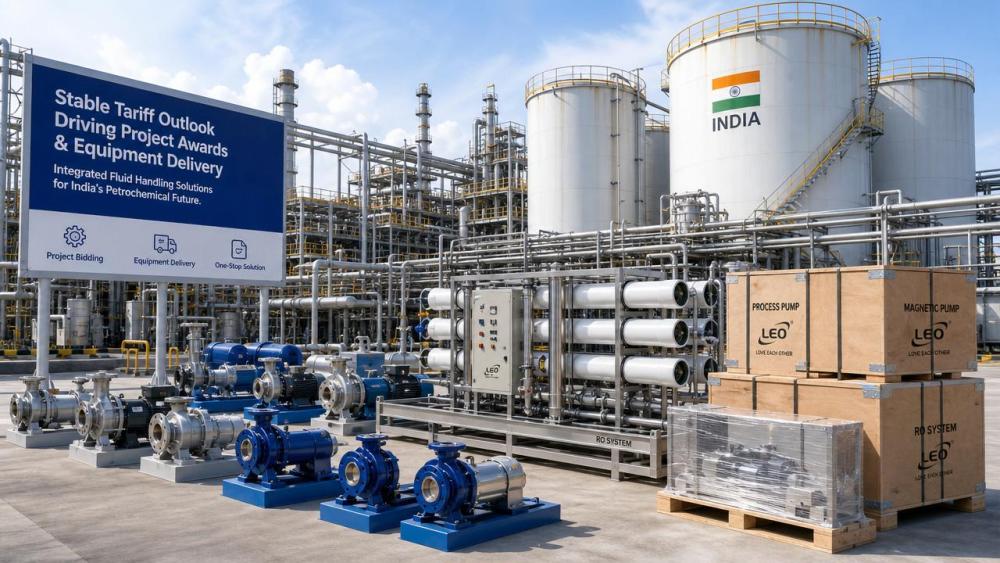
The same information indicates that this policy direction has a direct bearing on end-market demand and project implementation pace for supporting equipment exported from China, including chemical process pumps, industrial RO membranes, and magnetic drive pumps.
It is also confirmed that, for exporters serving the Indian market, a longer window of tariff stability would make customer procurement budgets more predictable and could accelerate project tendering, with particular relevance for suppliers able to provide integrated fluid handling and separation solutions.
Where the practical effects may be felt first
Export suppliers tied to petrochemical end-use projects
From an industry perspective, exporters of pumps, membranes, and related industrial equipment may be affected because their customers' investment timing often depends on the cost outlook for upstream or adjacent imported materials. If the tariff exemption window is extended, the main effect may appear in budget setting, quotation cycles, tender preparation, and project scheduling rather than in a simple one-step increase in orders.
What deserves closer attention is whether customers begin requesting firmer commercial offers, updated lead times, or more complete technical and delivery documentation during the extended policy window. Exporters should also watch whether bid packages increasingly require tighter alignment between equipment specifications and integrated process needs.
System providers offering combined transfer and separation packages
Suppliers that combine fluid transfer equipment with separation solutions may see a more immediate commercial advantage because the provided information specifically points to stronger relevance for this type of integrated offering. In practical terms, the impact may be felt in technical bid alignment, package scope definition, interface responsibility, and after-sales readiness.
Observably, these suppliers should pay close attention to whether customers seek single-vendor coordination for pumps, membranes, and related ancillary systems, since a faster tendering rhythm can shift more emphasis onto complete documentation, compatibility statements, and delivery coordination.
Procurement and supply-chain teams supporting India-bound orders
For procurement managers, planners, and logistics coordinators, the issue is not the exemption text alone but the possibility of a more stable purchasing horizon among Indian buyers. That can affect production slot allocation, component sourcing plans, shipment readiness, and handover documentation for export projects.
Analysis shows that these teams should focus on document consistency, specification traceability, and delivery commitments, because any acceleration in tendering or order conversion can expose weaknesses in internal coordination even before any formal market expansion is visible.
What companies should monitor while the policy remains under consideration
Watch the final wording and execution scope
The current development should be treated as a policy dynamic rather than a fully settled execution outcome. Companies should therefore monitor subsequent official wording, implementation scope, and any practical clarification affecting how the exemption period is understood in commercial planning.
Prepare bid files and technical documents early
If customers gain more confidence in procurement budgeting, tender processes may move faster. In that context, exporters may benefit from reviewing technical datasheets, compliance materials, testing records, product documentation, and bid-response packages in advance, especially for chemical process pumps, industrial RO membranes, and magnetic drive pumps.
Recheck delivery assumptions and supplier readiness
Because the provided information points to possible changes in project landing pace, companies should revisit lead-time assumptions, subcontractor coordination, and delivery commitments for India-bound projects. This is particularly relevant where one supplier is expected to support both fluid transport and separation functions within the same package.
Keep after-sales and traceability requirements visible
Even without new compliance details in the source material, exporters should remain alert to customer expectations on quality records, product traceability, service response, and handover documents. A more predictable tariff environment can improve commercial visibility, but it can also raise expectations around execution discipline once tenders move forward.
Why this is better read as a market signal than a completed rule change
Analysis shows that this development is more appropriately understood as an important policy signal rather than a fully finalized regulatory outcome. The confirmed information supports the view that tariff stability, if extended, may improve procurement predictability and project momentum for downstream industrial buyers, which in turn can influence export demand for supporting equipment.
At the same time, observably, the market still needs to watch for follow-up clarification, procurement behavior, and tender document changes before treating the impact as fully established. For industry participants, the practical question is less whether the headline is positive in principle and more how quickly it translates into executable projects, documentation requirements, and purchasing action.
How the sector may best interpret the current update
At this stage, the development is best viewed as a rule-related dynamic with clear commercial relevance but incomplete execution visibility. It points to a potentially more predictable window for India-facing petrochemical-linked procurement, which may support planning for pumps, RO membranes, magnetic drive pumps, and integrated system packages.
A neutral reading is therefore the most appropriate: the policy direction matters, the downstream connection appears real, but the industry should still assess it through subsequent implementation language, bid activity, and customer-side follow-through rather than assume immediate and uniform results.
Basis of this article and what still needs verification
This article is generated from the user-provided news title, event timing, and event summary. The specific official source link was not provided in the input, so any final interpretation still requires ongoing verification against relevant source types commonly associated with such developments, including official announcements, regulator releases, customs or trade authority information, industry association updates, standards-related documents, and reporting by authoritative media.
Further observation is still needed on the final policy wording, implementation interpretation, changes in tender documents, customer procurement behavior, industry feedback, and how exporters actually adjust execution, documentation, and delivery arrangements in response.
Related News
 When ZLD fouling in RO membranes requires more than cleaningSeparation Tech FellowZLD fouling in RO membranes: learn when CIP is no longer enough, how to identify irreversible damage, and which process changes protect recovery and reduce replacement costs.
 What Are the Risks of Skipping Pretreatment Before Zero Liquid Discharge?Separation Tech FellowWhat are the risks of skipping pretreatment before zero liquid discharge? Discover how poor feed conditioning drives fouling, scaling, corrosion, energy waste, and costly ZLD downtime.
 What drives reverse osmosis system price for industrial projects?Separation Tech FellowReverse osmosis system price explained: compare industrial RO costs, feedwater risks, energy use, recovery, and lifecycle value for smarter purchasing decisions.
 How to Evaluate a Membrane Separation Technology Supplier for Process Fit and Lifecycle CostSeparation Tech FellowMembrane separation technology supplier selection starts with process fit. Learn how to compare lifecycle cost, fouling control, engineering quality, and service support.
 US Rule Sets New Entry Tests for Industrial RO MembranesSeparation Tech FellowIndustrial RO membranes face new U.S. entry tests from Oct 1, 2026. Learn how DOE rules, PFAS bans, and certification checks may impact imports, compliance, and market access.
 EU Tightens CE Checks for RO MembranesSeparation Tech FellowEU Tightens CE Checks for RO Membranes: learn how new EU surveillance rules, third-party verification, and traceability demands may delay imports and reshape compliance for suppliers.
 EU REACH Update Adds Nano Disclosure for RO MembranesSeparation Tech FellowEU REACH Update Adds Nano Disclosure for RO Membranes: learn how new nanoform registration and SDS-Nano rules impact EU market access, customs clearance, and CE compliance.
 Revised EN 16798-4 Raises RO Energy ComplianceSeparation Tech FellowRevised EN 16798-4 raises EU energy compliance for Industrial RO Membranes, SWRO high-pressure pumps, and desalination systems. Learn key deadlines, DEP rules, and CE/UKCA cost impacts.
 FDA Adds 72-Hour Pre-Arrival Filing for RO MembranesSeparation Tech FellowFDA adds a 72-hour pre-arrival filing for industrial RO membranes and filtration components. Learn key compliance impacts, ACE filing needs, and how importers can avoid delays.
 EN 16754:2026 Adds Dual Certification for Industrial RO MembranesSeparation Tech FellowIndustrial RO membranes face a major EU compliance shift under EN 16754:2026. Learn how dual certification impacts exports, customs clearance, and supplier readiness before October 2026.
 FDA Import Alert Tightens RO Membrane Entry RulesSeparation Tech FellowFDA import alert update tightens RO membrane entry rules from Oct 1, 2026. Learn how chlorine resistance testing, ISO/IEC 17025 reports, and shipment compliance may impact exporters and importers.
 EU EN 14987:2026 Takes Effect for Industrial RO Membrane ExportsSeparation Tech FellowEU EN 14987:2026 now affects industrial RO membrane exports to Europe. Learn the new test requirements, customs risks, and buyer compliance steps to protect market access.