Aero-Thermodynamic Research Reshaping Compressor Efficiency




Aero-thermodynamic research is rapidly redefining compressor efficiency, giving industrial decision-makers a clearer view of how heat transfer, airflow behavior, and system design interact under real operating conditions. Across the broader machinery landscape, this shift matters because compressed air remains one of the most energy-intensive utilities in production, water treatment, chemicals, electronics, and infrastructure. As operating costs, carbon targets, and uptime expectations rise together, aero-thermodynamic research is no longer a niche engineering topic. It has become a practical lens for understanding why some air compressor systems now deliver lower specific power, better thermal stability, and more predictable lifecycle performance than legacy designs.
A measurable shift is underway in how compressor efficiency is evaluated
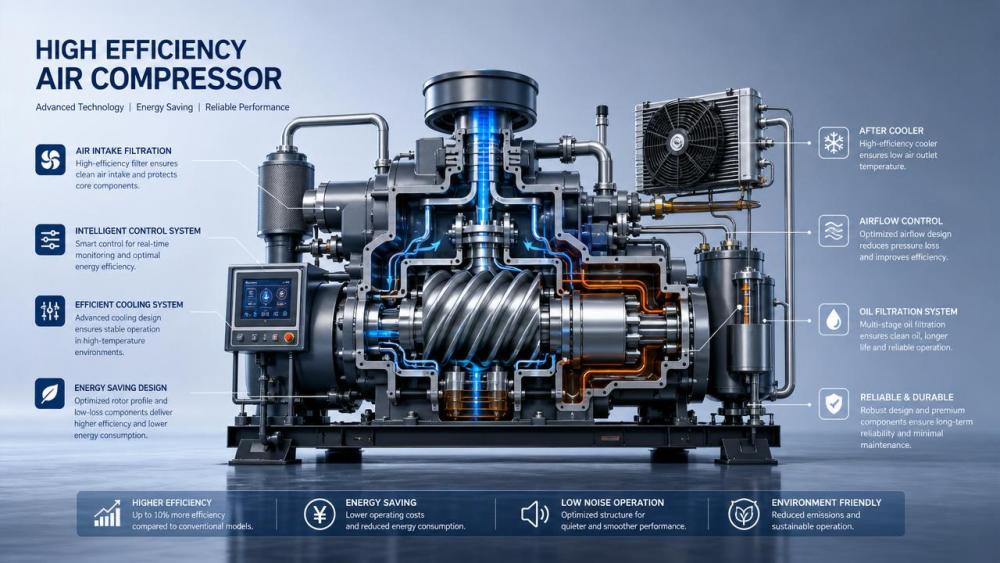
For years, compressor comparisons often centered on nameplate power, discharge pressure, or basic free air delivery. That approach is becoming incomplete. Aero-thermodynamic research shows that true efficiency depends on how air moves through the inlet, rotor or impeller path, intercooling stages, aftercooling sections, and downstream controls under varying load. In other words, compressor efficiency is now being judged as a dynamic system outcome, not only as a component rating.
This is especially relevant in integrated industrial environments where pumps, valves, filtration equipment, and compressed air networks interact with the same energy and process objectives. The same intelligence mindset that improves cavitation control in centrifugal pumps or flow stability in smart pneumatic valves is now being applied to compressor heat maps, pressure pulsation patterns, and rotor profile optimization. Aero-thermodynamic research connects these variables and reveals where hidden losses occur during compression, cooling, unloading, and part-load operation.
A second major change is the use of digital simulation and field validation together. Advanced CFD, thermal modeling, sensor feedback, and operating data are helping engineers verify whether a theoretically efficient design remains efficient after fouling, ambient temperature swings, pressure drops, and maintenance variation. This is why aero-thermodynamic research is influencing both equipment design and operating strategy at the same time.
The trend signals point to deeper integration of airflow science, thermal control, and decarbonization goals
Several trend signals explain why aero-thermodynamic research is gaining strategic weight in the general machinery sector. First, efficiency regulations and carbon accounting frameworks are pushing operators to quantify energy use more precisely. Second, permanent magnet variable frequency systems and two-stage compression are creating more opportunities to optimize partial-load behavior. Third, reliability expectations are increasing in industries where compressed air quality and continuity directly affect product yield, process stability, and safety.
At the same time, thermal inefficiency is becoming easier to detect and harder to ignore. Excess heat, unstable compression ratios, recirculation losses, and poor cooling effectiveness all translate into higher electricity use and shorter component life. Aero-thermodynamic research helps explain why these issues happen and where the best correction points exist, whether in inlet geometry, compression stage matching, lubricant thermal management, or control logic.
Key drivers accelerating this direction
Why aero-thermodynamic research is becoming a decision tool rather than a laboratory topic
The rise of aero-thermodynamic research reflects a broader industrial reality: compressors rarely operate at ideal steady-state conditions. Ambient temperature changes, dust loading, cooling water fluctuation, pressure setpoint adjustments, and demand cycling all reshape internal thermal and aerodynamic behavior. A design that looks efficient in a catalog may perform very differently in a real facility. Research in this area turns hidden physical interactions into visible decision data.
This has particular relevance for intelligence-led industrial platforms such as FCSM, where fluid dynamics, process control, and energy efficiency are viewed as connected rather than isolated disciplines. The same analytical discipline used to study valve noise at critical velocities or membrane separation under pressure differentials also helps interpret compressor rotor leakage, discharge temperature behavior, and intercooler effectiveness. Aero-thermodynamic research therefore supports not only product evolution but also clearer benchmarking across systems, sites, and operating profiles.
- It clarifies where energy is lost before, during, and after compression.
- It supports better matching between compressor type and application duty cycle.
- It improves confidence in retrofit priorities such as variable speed drives, stage redesign, or heat recovery.
- It reduces the gap between design efficiency claims and field performance reality.
The effects are spreading across design, operations, maintenance, and energy planning
The influence of aero-thermodynamic research is not limited to compressor OEM engineering teams. It is reshaping multiple business and technical links across the industrial chain. In design, it encourages better rotor or impeller profiles, reduced internal leakage, more effective cooling paths, and lower pressure-drop inlet systems. In operations, it supports finer pressure band control, lower unloaded running time, and more stable response to demand volatility.
Maintenance strategies are also changing. Thermal imbalance and airflow disruption often appear before major failure. When interpreted correctly, discharge temperature drift, abnormal pressure pulsation, or cooling inefficiency can become predictive indicators rather than late-stage alarms. This creates practical value for uptime-focused facilities that need compressors to behave as reliable utility assets rather than recurring energy liabilities.
Where the impact is most visible
- Equipment selection: More attention is being paid to part-load efficiency curves, not only rated full-load output.
- System integration: Compressor performance is increasingly evaluated with dryers, filters, piping, and control valves as one network.
- Reliability planning: Thermal stress mapping helps reduce bearing wear, lubricant degradation, and seal-related risk.
- Carbon strategy: Better aero-thermodynamic performance lowers electricity demand and improves the business case for energy upgrades.
The most important points to watch now are no longer purely mechanical
As aero-thermodynamic research reshapes compressor efficiency, the highest-value observations tend to sit at the intersection of mechanics, controls, thermals, and data. Focusing on only one layer often misses the real source of inefficiency. A modern review should examine how the machine breathes, how it sheds heat, how the controls react, and how the surrounding network amplifies or suppresses loss.
Priority watchpoints for ongoing evaluation
- Inlet air quality and inlet path resistance, which directly affect compression work.
- Intercooling and aftercooling effectiveness, especially in warm or variable climates.
- Rotor, screw, or impeller geometry updates enabled by simulation-led design.
- Variable frequency control behavior under cycling demand rather than ideal test loads.
- Heat recovery opportunities where compression waste heat can serve adjacent processes.
- Field data quality, because weak instrumentation can hide true aero-thermodynamic losses.
A practical response starts with better questions, not just new equipment
The most useful response to this trend is a structured evaluation framework. Instead of asking only whether a compressor is efficient, the stronger question is efficient under which pressure range, ambient condition, duty cycle, and network constraint. Aero-thermodynamic research becomes actionable when it is translated into site-specific checks and upgrade pathways.
Aero-thermodynamic research is likely to remain central as industrial systems become more efficient, more instrumented, and more carbon-accountable. The strongest outcomes will come from combining design intelligence, field monitoring, and cross-system analysis rather than treating compressors as isolated machines. That perspective aligns closely with the wider evolution of fluid control and system machinery, where performance, reliability, and energy value are increasingly judged together.
A useful next step is to compare current compressor behavior against real operating conditions, especially part-load efficiency, temperature distribution, and pressure stability. From there, aero-thermodynamic research can guide whether the better move is retrofit, control optimization, thermal improvement, or a broader system redesign. In a market where compressed air must support both productivity and decarbonization, that level of clarity is becoming a competitive advantage.
Related News
 What drives industrial wastewater treatment cost per cubic meter?Dr. Alistair VaughnIndustrial wastewater treatment cost per cubic meter depends on influent load, effluent targets, energy, technology, and sludge disposal. Explore the key cost drivers.
 How to verify CE compliance for fluid separation equipmentDr. Alistair VaughnFluid separation equipment CE verification made practical: learn how to check declarations, risk assessments, technical files, pressure safety, and installation readiness.
 Separation equipment trends reshaping industrial wastewater treatmentDr. Alistair VaughnSeparation equipment trends are reshaping industrial wastewater treatment through smarter membranes, modular systems, digital monitoring, and resource recovery strategies.
 When stainless steel separation equipment is the right choice for hygienic processesDr. Alistair VaughnStainless steel separation equipment: discover when hygienic design, corrosion resistance, CIP cleanability, and lifecycle reliability make it the smart choice.
 What to assess before choosing a process industry automation supplierDr. Alistair VaughnChoose a process industry automation supplier with confidence. Assess engineering depth, lifecycle reliability, digital integration, energy performance, and safety before you buy.
 How process control innovation in refineries reduces unplanned shutdownsDr. Alistair VaughnDiscover how process control innovation in refineries detects early deviations, improves valve and equipment reliability, and helps prevent costly unplanned shutdowns.
 What should a zero liquid discharge systems integrator include in its proposal?Dr. Alistair VaughnZero liquid discharge systems integrator proposal checklist: compare guarantees, utilities, scope, controls, waste handling, and lifecycle risk before award.
 Industrial wastewater treatment plant design: sizing for flow and loadDr. Alistair VaughnIndustrial wastewater treatment plant design guide: size systems for peak flow, pollutant loads, reliability, compliance, and lower lifecycle costs.
 Can predictive maintenance and machinery diagnostics prevent downtime?Dr. Alistair VaughnPredictive maintenance machinery diagnostics help reduce unplanned downtime by detecting early equipment issues, improving reliability, and enabling smarter maintenance decisions.
 Can a digital transformation machinery platform cut unplanned downtime?Dr. Alistair VaughnDiscover how a digital transformation machinery platform connects asset data, maintenance workflows, and process insights to reduce unplanned downtime.
 How water treatment equipment sizing affects operating costsDr. Alistair VaughnWater treatment equipment sizing shapes energy, chemical, and maintenance costs. Learn how to balance flow, pressure, recovery, and reliability for efficient operation.
 When does food processing automation justify the upfront investment?Dr. Alistair VaughnIndustrial automation solutions for food processing: discover when automation delivers measurable ROI through higher throughput, lower waste, reliable utilities, and stronger food safety control.