Automation Maintenance Services: What Matters Most




For after-sales maintenance teams, keeping automated systems reliable means more than fixing faults—it requires speed, precision, and lifecycle insight. In today’s process industries, industrial automation solutions maintenance services matter most when they reduce downtime, improve energy efficiency, and support predictive care across pumps, valves, compressors, and separation equipment. This article highlights the priorities that truly impact performance and service success.
What After-Sales Teams Really Need From Automation Maintenance Services
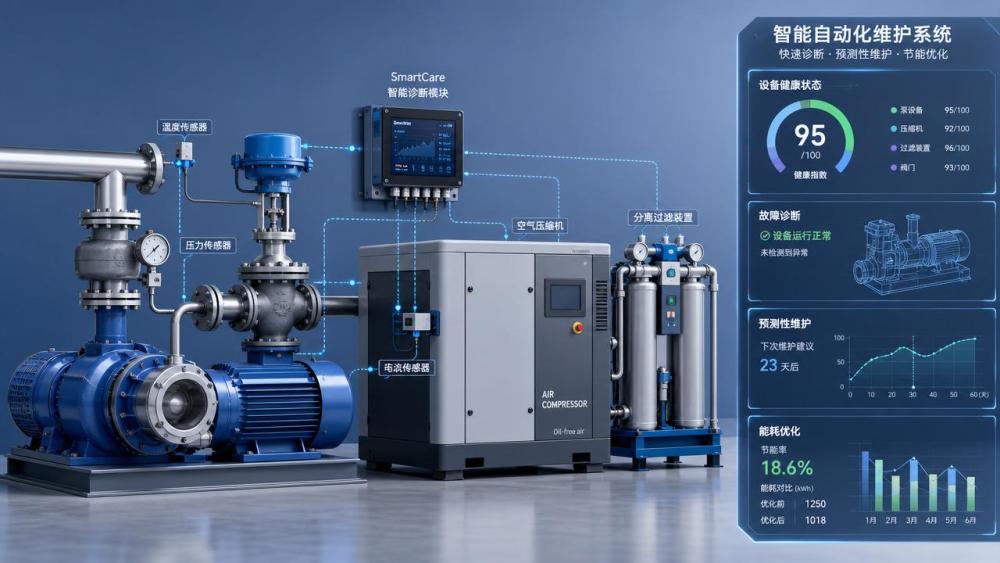
When people search for automation maintenance services, they usually want practical answers, not broad theory. They need to know which service elements actually protect uptime, cut repeat failures, and improve asset performance.
For after-sales maintenance personnel, the central question is simple: what helps me keep systems stable, restore operation fast, and avoid the same problem returning next month? Everything else is secondary.
That is why the most valuable industrial automation solutions maintenance services are not defined by how many tasks are listed in a contract. They are defined by response quality, diagnostic depth, and measurable lifecycle results.
In process industries, automation is tightly linked to rotating equipment, flow control, compressed air, and separation systems. A small fault in instrumentation or logic can quickly affect pump efficiency, valve stability, or compressor energy use.
So the best maintenance model is one that connects controls, mechanics, process conditions, and operating history. It should help service teams move from isolated troubleshooting toward whole-system reliability.
Fast Recovery Matters, But Accurate Diagnosis Matters More
Many sites still judge maintenance quality mainly by response speed. Speed is important, especially when production losses are rising by the minute. But quick arrival alone does not guarantee good service outcomes.
If technicians replace components without finding the true cause, downtime may return in days. This creates extra labor, emergency parts consumption, and loss of trust between service teams and plant operators.
Accurate diagnosis is therefore one of the most important features of effective automation maintenance services. Teams should be able to determine whether the root issue comes from hardware, software, calibration drift, process upset, or operator interaction.
For example, unstable flow control may not come from a valve actuator failure. It could result from poor tuning, air supply fluctuation, sensor noise, cavitation in a pump, or mismatch between process load and control strategy.
Good after-sales service teams use fault trees, event logs, trend analysis, and device health data to separate symptoms from causes. This approach reduces unnecessary replacement and supports more permanent corrective action.
Downtime Reduction Should Be Measured Across the Whole System
Maintenance teams often focus on restoring a failed device. However, automated process systems should be assessed at the line or unit level, not only at the component level.
A repaired PLC input card means little if the connected compressor still cycles excessively, a control valve continues hunting, or a filtration skid remains unable to maintain stable pressure. True service value is system recovery.
That is why industrial automation solutions maintenance services should include operating verification after repair. The work is not finished when an alarm clears. It is finished when the process returns to stable and efficient performance.
For pump systems, this may mean checking vibration trends, pressure balance, and motor load after restoring control logic. For air compressors, it may involve confirming sequencing, leakage response, and variable frequency behavior.
For pneumatic valves and separation equipment, maintenance teams should verify stroke accuracy, control signal stability, and process consistency under real operating conditions. These checks help prove that downtime has been truly resolved.
Predictive Maintenance Is Only Useful When It Leads to Action
Predictive maintenance is often promoted as the future of industrial service, and for good reason. Early warnings can prevent major outages, reduce spare parts waste, and improve planning across complex facilities.
But predictive maintenance has little value if teams collect data without translating it into service decisions. After-sales teams need alerts that are clear, relevant, and tied to practical maintenance actions.
In automated fluid machinery, useful predictive indicators include vibration change, actuator response delay, abnormal energy draw, discharge pressure deviation, temperature drift, and repeated control loop instability.
These signals become powerful only when maintenance teams know what threshold matters, what failure mode is likely, and what intervention should come next. Data without service interpretation simply creates more noise.
Strong maintenance services therefore combine monitoring tools with engineering judgment. They help teams prioritize risks, schedule interventions during planned windows, and prevent faults before they become production interruptions.
Equipment Knowledge Must Match Process Knowledge
One common weakness in maintenance support is treating automation as separate from the process itself. In reality, good service for pumps, valves, compressors, and filtration units requires understanding both control systems and operating physics.
A technician may know how to replace a transmitter, but if they do not understand cavitation risk, pressure pulsation, or thermodynamic loading, they may miss the real reason behind repeated signal abnormalities.
For centrifugal pumps, automation maintenance can involve level control, VFD behavior, suction protection, and alarm logic. Yet those controls only make sense when linked to hydraulic performance and process demand.
For smart pneumatic control valves, service teams must understand positioner calibration, feedback communication, air quality, and control loop behavior. At the same time, they should assess valve sizing, trim wear, and flow conditions.
For air compressor systems, automation service should not stop at controller faults. It should also address sequencing logic, load-unload efficiency, pressure band management, and interactions with downstream plant air demand.
This is why the best maintenance providers bring multidisciplinary capability. They combine controls knowledge with machinery insight and process awareness, allowing after-sales teams to solve issues more completely.
Energy Efficiency Is No Longer a Secondary Maintenance Goal
In many facilities, maintenance has traditionally been measured by reliability alone. Today, that is no longer enough. Energy use is now a critical part of equipment performance, especially in fluid and gas systems.
Pumps, compressors, and control valves can continue running while gradually becoming less efficient. If maintenance teams focus only on failure prevention, they may miss hidden losses that increase operating cost every day.
Effective automation maintenance services should therefore include energy-related checks. These may involve reviewing motor loading, control setpoints, pressure stability, compressor cycling, and unnecessary throttling in valve networks.
A poorly tuned control loop can force pumps to operate away from best efficiency point. An unstable compressor sequence can increase unloaded running. A drifting sensor can lead to overpressure, overtreatment, or excessive recirculation.
From an after-sales perspective, energy optimization also strengthens service value. It shows that maintenance is not only a repair function, but also a contributor to plant performance, sustainability goals, and cost reduction.
Standardization Makes Service More Reliable Across Different Sites
After-sales maintenance teams often support multiple customers, equipment brands, or facility types. Without standard methods, service quality can become inconsistent, especially when teams are under time pressure.
Standardization does not mean rigid service. It means creating repeatable foundations for inspection, diagnostics, reporting, and post-repair verification. These foundations improve speed and reduce overlooked details.
Useful standards include alarm review templates, calibration procedures, root cause documentation, spare parts classification, loop-check protocols, and digital maintenance records linked to asset history.
For industrial automation solutions maintenance services, standardization is especially valuable because many failures repeat in similar patterns. Historical service data can reveal chronic instrument drift, poor air preparation, unstable VFD settings, or weak commissioning practices.
When after-sales teams work from structured processes, they can identify those patterns earlier. This improves service consistency and supports better recommendations for long-term system improvement.
Spare Parts Strategy Is Part of Maintenance Quality
Maintenance performance is often judged after a breakdown, but preparation before failure is equally important. Spare parts strategy has a major impact on how quickly and safely systems can be restored.
Critical automation assets may include transmitters, I/O modules, valve positioners, pressure switches, relays, communication modules, and actuator repair kits. For rotating machinery systems, certain mechanical and control parts should be planned together.
If a team replaces a failed automation component but cannot address the related mechanical risk, the repair may remain incomplete. This is especially relevant in integrated pump, compressor, and valve applications.
After-sales teams should help customers classify spares by criticality, lead time, failure probability, and process consequence. A low-cost part with long procurement delay can create major downtime risk if not stocked correctly.
Good maintenance services therefore include spare parts planning, interchangeability guidance, and lifecycle support for obsolete or upgraded components. This reduces emergency dependence and improves service readiness.
Remote Support Works Best When the Digital Foundation Is Strong
Remote diagnostics and connected service models are becoming standard in many industrial environments. They can shorten response times and help senior specialists support field teams without travel delays.
However, remote maintenance only works well when systems are properly configured. Data access, alarm quality, communication security, and device visibility all affect whether remote support will be useful in real fault conditions.
For after-sales teams, the priority is not simply to add connectivity. The priority is to ensure that remote access helps resolve issues faster, with clear responsibilities and safe operational controls.
Strong digital maintenance support may include remote trend review, firmware checks, logic backup validation, performance benchmarking, and guided troubleshooting for local technicians working on site.
When supported by secure architecture and disciplined documentation, remote service can improve coverage across geographically dispersed assets while reducing mean time to resolution.
How to Judge Whether a Maintenance Service Model Is Actually Effective
After-sales teams and plant users both benefit from clear evaluation criteria. Without them, service quality becomes subjective and difficult to improve over time.
The most useful indicators are practical and outcome-focused. These include repeat failure rate, mean time to diagnose, mean time to repair, percentage of planned versus emergency interventions, and post-service process stability.
Energy indicators also matter, especially in compressor and pump systems. A service model that restores operation but leaves hidden inefficiencies is only partially successful.
Teams should also review whether maintenance reports identify root causes, recommend prevention steps, and record configuration changes clearly. Good documentation supports future troubleshooting and protects knowledge continuity.
In short, effective industrial automation solutions maintenance services should make systems more reliable, more predictable, and easier to support over time. If those outcomes are not visible, the service model needs improvement.
What Matters Most in the End
For after-sales maintenance personnel, the value of automation maintenance services comes down to a few essentials. First, they must restore operation quickly without sacrificing diagnostic accuracy.
Second, they must reduce repeat failures by linking controls knowledge with process and equipment understanding. Third, they should support predictive action, not just reactive repair.
Fourth, they should improve energy performance as well as reliability. Finally, they must create consistency through standard methods, useful data, and practical spare parts planning.
In modern process industries, automated assets are too interconnected for maintenance to remain narrow or purely reactive. Pumps, valves, compressors, and separation systems all depend on smart service that sees the whole operating picture.
That is what matters most: maintenance services that help after-sales teams move beyond fault response and toward measurable lifecycle performance. When service does that, it delivers real value to both technicians and the plants they support.
Related News
 What drives industrial wastewater treatment cost per cubic meter?Dr. Alistair VaughnIndustrial wastewater treatment cost per cubic meter depends on influent load, effluent targets, energy, technology, and sludge disposal. Explore the key cost drivers.
 How to verify CE compliance for fluid separation equipmentDr. Alistair VaughnFluid separation equipment CE verification made practical: learn how to check declarations, risk assessments, technical files, pressure safety, and installation readiness.
 Separation equipment trends reshaping industrial wastewater treatmentDr. Alistair VaughnSeparation equipment trends are reshaping industrial wastewater treatment through smarter membranes, modular systems, digital monitoring, and resource recovery strategies.
 When stainless steel separation equipment is the right choice for hygienic processesDr. Alistair VaughnStainless steel separation equipment: discover when hygienic design, corrosion resistance, CIP cleanability, and lifecycle reliability make it the smart choice.
 What to assess before choosing a process industry automation supplierDr. Alistair VaughnChoose a process industry automation supplier with confidence. Assess engineering depth, lifecycle reliability, digital integration, energy performance, and safety before you buy.
 How process control innovation in refineries reduces unplanned shutdownsDr. Alistair VaughnDiscover how process control innovation in refineries detects early deviations, improves valve and equipment reliability, and helps prevent costly unplanned shutdowns.
 What should a zero liquid discharge systems integrator include in its proposal?Dr. Alistair VaughnZero liquid discharge systems integrator proposal checklist: compare guarantees, utilities, scope, controls, waste handling, and lifecycle risk before award.
 Industrial wastewater treatment plant design: sizing for flow and loadDr. Alistair VaughnIndustrial wastewater treatment plant design guide: size systems for peak flow, pollutant loads, reliability, compliance, and lower lifecycle costs.
 Can predictive maintenance and machinery diagnostics prevent downtime?Dr. Alistair VaughnPredictive maintenance machinery diagnostics help reduce unplanned downtime by detecting early equipment issues, improving reliability, and enabling smarter maintenance decisions.
 Can a digital transformation machinery platform cut unplanned downtime?Dr. Alistair VaughnDiscover how a digital transformation machinery platform connects asset data, maintenance workflows, and process insights to reduce unplanned downtime.
 How water treatment equipment sizing affects operating costsDr. Alistair VaughnWater treatment equipment sizing shapes energy, chemical, and maintenance costs. Learn how to balance flow, pressure, recovery, and reliability for efficient operation.
 When does food processing automation justify the upfront investment?Dr. Alistair VaughnIndustrial automation solutions for food processing: discover when automation delivers measurable ROI through higher throughput, lower waste, reliable utilities, and stronger food safety control.