Custom Industrial Automation Solutions: Build vs Integrate




Custom Industrial Automation Solutions: Build vs Integrate
For many industrial projects, the hardest choice is not whether to automate.
It is whether custom industrial automation solutions should be built from scratch or integrated from proven parts.
That choice shapes capital efficiency, deployment speed, data visibility, and operational resilience.
It also affects how well an automation roadmap supports digital transformation and decarbonization goals.
In sectors tied to pumps, compressors, smart valves, and filtration systems, the stakes are especially high.
A poor architecture decision can lock in maintenance burdens for years.
A smart one can improve uptime, energy efficiency, and process control across the full asset lifecycle.
This is why custom industrial automation solutions deserve evaluation beyond the initial price tag.
What Build and Integrate Really Mean
Build means designing more of the control architecture around specific workflows, assets, and plant conditions.
That may include custom PLC logic, edge analytics, dashboards, interfaces, and device coordination.
Integrate means combining established hardware and software into a working system with less bespoke engineering.
This often uses standard communication protocols, packaged modules, and vendor-tested control strategies.
In practice, most custom industrial automation solutions fall somewhere between these two extremes.
For example, a compressor station may use standard drives and sensors but a custom optimization layer.
A valve control skid may rely on standard actuators but require tailored logic for corrosive service conditions.
When Building Custom Industrial Automation Solutions Makes Sense
Building becomes attractive when the process itself creates differentiation or unusual technical demands.
That is common in advanced fluid control environments where process stability depends on precise, dynamic adjustments.
A custom design may be justified when standard packages cannot address cavitation, pulsation, or energy balancing well enough.
It also fits plants with mixed legacy equipment, fragmented data, and strict internal operating standards.
- The process has unique control logic linked to product quality or safety.
- Assets come from many vendors and do not align well out of the box.
- The site needs advanced diagnostics, predictive maintenance, or energy optimization.
- Future expansion requires a flexible architecture rather than fixed packaged functions.
From a strategic angle, building custom industrial automation solutions can protect long-term process know-how.
It may also reduce dependence on one vendor’s roadmap, pricing model, or software ecosystem.
Still, greater control comes with more engineering responsibility and a longer payback horizon.
When Integration Is the Smarter Decision
Integration is often the better path when speed, reliability, and lower implementation risk matter most.
Many facilities do not need fully bespoke control layers to achieve strong operational gains.
They need faster visibility, cleaner interoperability, and dependable performance under real plant conditions.
Integrated custom industrial automation solutions can deliver that with lower development complexity.
- The operation uses standard process steps with limited variability.
- Project timelines are tight and production disruption must stay minimal.
- Internal teams prefer vendor-backed support and proven validation histories.
- Cybersecurity, compliance, and spare parts management favor standard platforms.
This path is especially effective for compressor systems, pump skids, and packaged separation units.
Those systems often benefit from tested controls, mature drives, and standard remote monitoring functions.
The result is not generic automation.
It is targeted integration with fewer unknowns and faster operational value.
A Practical Comparison for Decision-Making
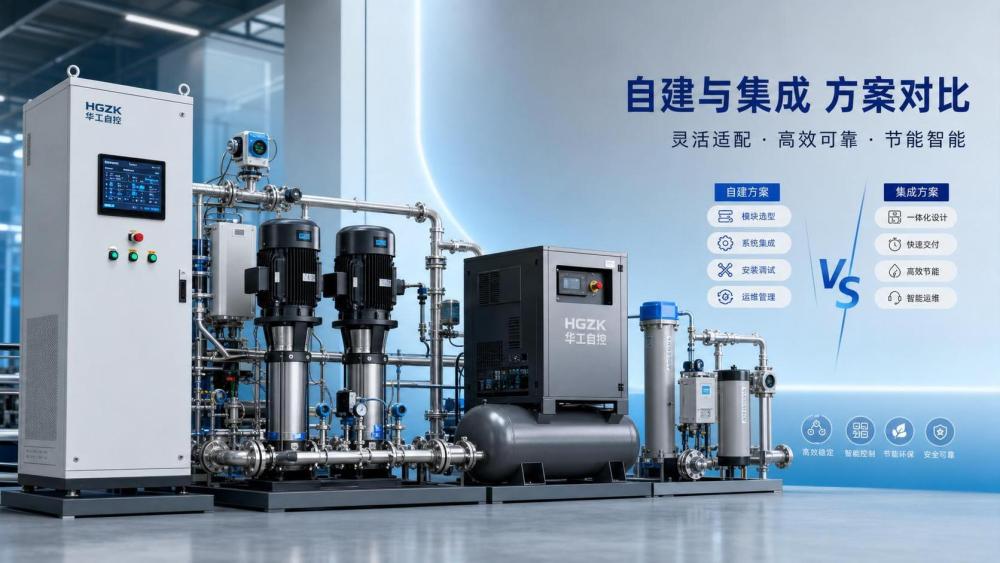
A side-by-side view makes the trade-offs easier to judge.
This comparison shows why custom industrial automation solutions should be judged by business fit, not ideology.
The best answer is the one that aligns technical design with measurable operating priorities.
Cost, Risk, and ROI Beyond the Purchase Price
Initial cost gets attention, but lifecycle cost drives the real economics.
That includes commissioning time, operator training, software maintenance, spare parts, energy use, and downtime exposure.
Built custom industrial automation solutions may carry higher early spending.
Yet they can create stronger ROI if they unlock better throughput, lower waste, or tighter energy control.
Integrated solutions usually reduce delivery risk and compress time to value.
That matters when market demand is strong or utility costs are rising quickly.
In fluid-intensive operations, energy efficiency often changes the financial picture more than hardware cost alone.
A better compressor control sequence or variable pump strategy can return value every hour.
That is why ROI models should include process stability, maintenance labor, and digital reporting value.
Questions That Improve Selection Quality
A better decision usually starts with better questions.
- Which process constraints are truly unique, and which are standard?
- How much downtime can the site tolerate during migration and commissioning?
- What data must be visible for maintenance, compliance, and energy management?
- Will the control architecture need to support acquisitions, capacity growth, or new product lines?
- Does the team have internal capability to support a more custom environment?
- Where is vendor lock-in acceptable, and where is it a strategic risk?
These questions bring structure to the evaluation of custom industrial automation solutions.
They also reveal whether the project is solving a control problem, a data problem, or a scaling problem.
That distinction matters because each issue points to a different design approach.
Why Hybrid Strategies Often Win
Many of the strongest outcomes come from hybrid thinking.
Use standard building blocks where maturity is valuable.
Customize only where process value, risk reduction, or competitive differentiation clearly justify it.
This model works well for custom industrial automation solutions in pumping, valve control, compressed air, and separation systems.
For instance, a site may integrate standard drives, IIoT gateways, and HMIs.
At the same time, it may build custom algorithms for cavitation prevention, leak detection, or load balancing.
That reduces cost and deployment risk without sacrificing operational intelligence.
Final Takeaway
The build-versus-integrate decision is really a fit-versus-speed decision.
Custom industrial automation solutions should be selected by matching technical ambition to business reality.
If the process is unique, high-risk, or strategically important, building more may create lasting value.
If the priority is faster deployment, predictable support, and lower execution risk, integration often wins.
In actual operations, the best path is often a balanced architecture with selective customization.
Start with process needs, validate lifecycle economics, and map the support model before committing.
That approach turns custom industrial automation solutions from a technical purchase into a stronger strategic investment.
Related News
 What drives industrial wastewater treatment cost per cubic meter?Dr. Alistair VaughnIndustrial wastewater treatment cost per cubic meter depends on influent load, effluent targets, energy, technology, and sludge disposal. Explore the key cost drivers.
 How to verify CE compliance for fluid separation equipmentDr. Alistair VaughnFluid separation equipment CE verification made practical: learn how to check declarations, risk assessments, technical files, pressure safety, and installation readiness.
 Separation equipment trends reshaping industrial wastewater treatmentDr. Alistair VaughnSeparation equipment trends are reshaping industrial wastewater treatment through smarter membranes, modular systems, digital monitoring, and resource recovery strategies.
 When stainless steel separation equipment is the right choice for hygienic processesDr. Alistair VaughnStainless steel separation equipment: discover when hygienic design, corrosion resistance, CIP cleanability, and lifecycle reliability make it the smart choice.
 What to assess before choosing a process industry automation supplierDr. Alistair VaughnChoose a process industry automation supplier with confidence. Assess engineering depth, lifecycle reliability, digital integration, energy performance, and safety before you buy.
 How process control innovation in refineries reduces unplanned shutdownsDr. Alistair VaughnDiscover how process control innovation in refineries detects early deviations, improves valve and equipment reliability, and helps prevent costly unplanned shutdowns.
 What should a zero liquid discharge systems integrator include in its proposal?Dr. Alistair VaughnZero liquid discharge systems integrator proposal checklist: compare guarantees, utilities, scope, controls, waste handling, and lifecycle risk before award.
 Industrial wastewater treatment plant design: sizing for flow and loadDr. Alistair VaughnIndustrial wastewater treatment plant design guide: size systems for peak flow, pollutant loads, reliability, compliance, and lower lifecycle costs.
 Can predictive maintenance and machinery diagnostics prevent downtime?Dr. Alistair VaughnPredictive maintenance machinery diagnostics help reduce unplanned downtime by detecting early equipment issues, improving reliability, and enabling smarter maintenance decisions.
 Can a digital transformation machinery platform cut unplanned downtime?Dr. Alistair VaughnDiscover how a digital transformation machinery platform connects asset data, maintenance workflows, and process insights to reduce unplanned downtime.
 How water treatment equipment sizing affects operating costsDr. Alistair VaughnWater treatment equipment sizing shapes energy, chemical, and maintenance costs. Learn how to balance flow, pressure, recovery, and reliability for efficient operation.
 When does food processing automation justify the upfront investment?Dr. Alistair VaughnIndustrial automation solutions for food processing: discover when automation delivers measurable ROI through higher throughput, lower waste, reliable utilities, and stronger food safety control.