Decanter Centrifuge Equipment Selection: Key Performance Factors




Decanter Centrifuge Equipment Selection: Key Performance Factors
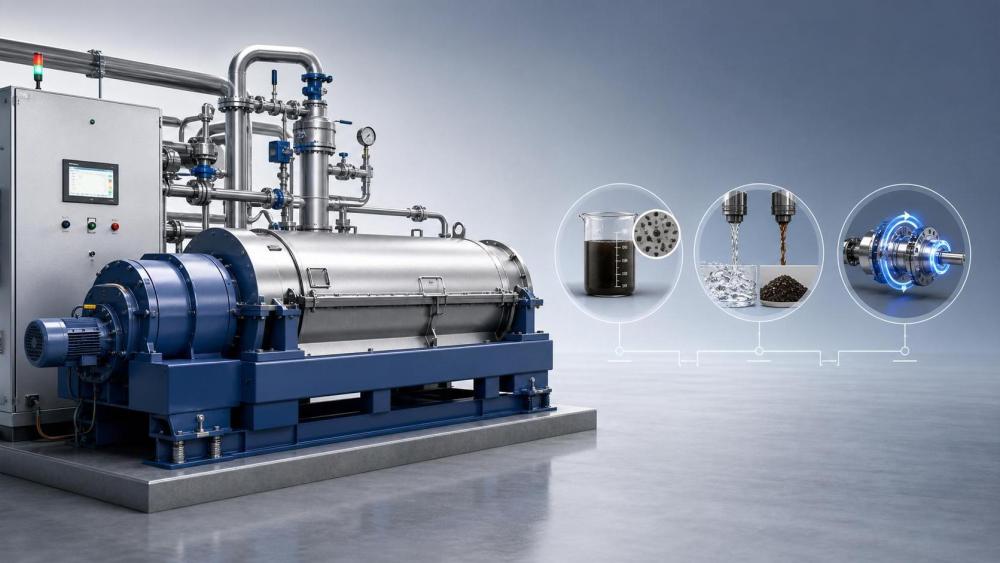
Selecting decanter centrifuge equipment starts with process reality, not brochure capacity.
A machine that looks efficient on paper may struggle with unstable feed, abrasive solids, or tighter dryness targets.
That is why equipment selection should focus on measurable performance under actual operating conditions.
For most plants, the decision is tied to uptime, product recovery, maintenance frequency, and total operating cost.
In practice, decanter centrifuge equipment must fit the process window, not force the process to fit the machine.
This is especially true in wastewater, food, chemical, mining, and oil-related separation duties.
A sound evaluation usually compares separation performance, feed variability, torque margin, wear life, controls, and lifecycle economics.
Once these factors are mapped clearly, decanter centrifuge equipment selection becomes far less risky.
Start with Feed Characteristics, Not Nameplate Throughput
The first screening step is understanding the feed in detail.
Flow rate matters, but solids concentration, particle size distribution, viscosity, density difference, and temperature often matter more.
Small shifts in feed composition can change cake dryness and centrate clarity very quickly.
This also affects whether standard decanter centrifuge equipment can hold stable performance across daily fluctuations.
In municipal sludge, polymer response is often just as important as sludge concentration.
In food and biochemical applications, shear sensitivity and product integrity may dominate the selection process.
For abrasive mineral slurries, solids hardness and sharpness can outweigh throughput claims.
- Define normal, minimum, and peak feed rates.
- Record solids percentage and expected seasonal variation.
- Check whether the material is fibrous, sticky, foaming, or abrasive.
- Confirm pH, chloride level, and corrosive components.
- Assess whether upstream dosing conditions are stable enough.
Without this dataset, selecting decanter centrifuge equipment becomes guesswork dressed up as engineering.
Focus on Separation Efficiency and Solids Capture
The next question is simple: what separation result is actually required?
Some processes prioritize dry cake for transport cost reduction.
Others care more about liquid clarity, solids recovery, or product yield.
A good decanter centrifuge equipment review separates these targets instead of treating them as one number.
High bowl speed can improve fine particle capture, but it may increase energy demand and wear.
A longer pond depth may support clarification, yet it can influence solids residence time.
That balance must be tested against the application, not assumed from generic vendor charts.
Key Performance Indicators Worth Comparing
- Cake dryness under stable and variable loads.
- Centrate suspended solids level.
- Solids capture efficiency across particle ranges.
- Product loss in the liquid phase.
- Polymer or chemical consumption per ton processed.
When these indicators are defined early, decanter centrifuge equipment selection becomes more objective and easier to defend internally.
Differential Speed and Torque Often Decide Real-World Stability
Many buying decisions focus too heavily on bowl diameter and installed motor power.
However, differential speed and conveyor torque usually determine whether the machine runs smoothly under upset conditions.
Differential speed controls solids transport through the bowl.
If it is too high, solids may leave wetter than expected.
If it is too low, torque spikes, beach overload, and plugging risk increase.
For sticky, dense, or fast-changing feed, torque reserve is not optional.
It is the difference between controlled operation and repeated trips.
Questions to Ask Suppliers
- What is the usable differential speed range, not just the nominal setting?
- How does torque control respond during feed spikes?
- Can the drive system recover from overload without manual intervention?
- What operating data proves stable performance at similar solids loading?
This is where decanter centrifuge equipment comparisons become meaningful, because dynamic control capability often matters more than peak specification numbers.
Material Selection and Wear Protection Affect Lifecycle Cost
A low purchase price can disappear quickly if wear parts fail early.
This is especially visible in sludge, drilling mud, mining tailings, and crystallizing chemical service.
The right decanter centrifuge equipment should match metallurgy and wear protection to both chemistry and solids behavior.
Stainless grades, duplex materials, tungsten carbide tiles, ceramic protection, and replaceable wear liners all have different cost logic.
The best choice depends on expected run hours, maintenance access, and shutdown cost.
When maintenance labor is expensive, stronger wear design often delivers the lower total cost.
Automation, Control Logic, and Serviceability Matter More Than Before
Recent procurement trends show a clear shift toward smarter and easier-to-manage systems.
Plants want decanter centrifuge equipment that can respond to feed changes with less operator intervention.
Variable frequency drives, torque-based control, vibration monitoring, and condition alarms now shape many final decisions.
This also means control architecture should align with the site standard.
If spare parts, PLC integration, or remote diagnostics are difficult, the ownership burden rises fast.
Serviceability should be reviewed with the same discipline as process performance.
- Access time for scroll, bearings, and wear parts.
- Availability of local technical support.
- Lead time for critical spares.
- Compatibility with plant instrumentation and data systems.
- Clarity of maintenance procedures and training support.
In many facilities, these practical points end up deciding which decanter centrifuge equipment performs best over five years.
Use Lifecycle Economics to Make the Final Decision
Final selection should bring process, mechanical, and financial data into one decision model.
Purchase price is only one line in the picture.
Energy use, polymer demand, spare consumption, maintenance intervals, and lost production risk usually have greater long-term impact.
A cheaper machine with unstable separation can create higher disposal cost, more operator attention, and lower recovery value.
That is why decanter centrifuge equipment selection should be validated through trials, reference checks, and a structured comparison sheet.
A Practical Evaluation Sequence
- Define target outcomes for dryness, clarity, and recovery.
- Gather feed data from normal and upset conditions.
- Shortlist decanter centrifuge equipment with comparable design basis.
- Compare torque margin, wear design, and control capability.
- Model operating cost over realistic annual run hours.
- Verify claims through pilot testing or proven references.
The strongest choice is usually the one that holds stable performance with the least operational compromise.
For FCSM readers tracking smart fluid systems, this selection discipline also supports broader goals around efficiency, reliability, and lower lifecycle emissions.
When the process demands are clear, decanter centrifuge equipment can be selected with confidence, backed by data instead of assumptions.
Related News
 What drives industrial wastewater treatment cost per cubic meter?Dr. Alistair VaughnIndustrial wastewater treatment cost per cubic meter depends on influent load, effluent targets, energy, technology, and sludge disposal. Explore the key cost drivers.
 How to verify CE compliance for fluid separation equipmentDr. Alistair VaughnFluid separation equipment CE verification made practical: learn how to check declarations, risk assessments, technical files, pressure safety, and installation readiness.
 Separation equipment trends reshaping industrial wastewater treatmentDr. Alistair VaughnSeparation equipment trends are reshaping industrial wastewater treatment through smarter membranes, modular systems, digital monitoring, and resource recovery strategies.
 When stainless steel separation equipment is the right choice for hygienic processesDr. Alistair VaughnStainless steel separation equipment: discover when hygienic design, corrosion resistance, CIP cleanability, and lifecycle reliability make it the smart choice.
 What to assess before choosing a process industry automation supplierDr. Alistair VaughnChoose a process industry automation supplier with confidence. Assess engineering depth, lifecycle reliability, digital integration, energy performance, and safety before you buy.
 How process control innovation in refineries reduces unplanned shutdownsDr. Alistair VaughnDiscover how process control innovation in refineries detects early deviations, improves valve and equipment reliability, and helps prevent costly unplanned shutdowns.
 What should a zero liquid discharge systems integrator include in its proposal?Dr. Alistair VaughnZero liquid discharge systems integrator proposal checklist: compare guarantees, utilities, scope, controls, waste handling, and lifecycle risk before award.
 Industrial wastewater treatment plant design: sizing for flow and loadDr. Alistair VaughnIndustrial wastewater treatment plant design guide: size systems for peak flow, pollutant loads, reliability, compliance, and lower lifecycle costs.
 Can predictive maintenance and machinery diagnostics prevent downtime?Dr. Alistair VaughnPredictive maintenance machinery diagnostics help reduce unplanned downtime by detecting early equipment issues, improving reliability, and enabling smarter maintenance decisions.
 Can a digital transformation machinery platform cut unplanned downtime?Dr. Alistair VaughnDiscover how a digital transformation machinery platform connects asset data, maintenance workflows, and process insights to reduce unplanned downtime.
 How water treatment equipment sizing affects operating costsDr. Alistair VaughnWater treatment equipment sizing shapes energy, chemical, and maintenance costs. Learn how to balance flow, pressure, recovery, and reliability for efficient operation.
 When does food processing automation justify the upfront investment?Dr. Alistair VaughnIndustrial automation solutions for food processing: discover when automation delivers measurable ROI through higher throughput, lower waste, reliable utilities, and stronger food safety control.