Industrial Machinery Trends 2026: Energy, Automation, and ROI Signals




Industrial machinery trends 2026 are coming into focus through a harder business lens. Energy costs remain volatile, automation budgets are becoming more selective, and capital approval now depends on measurable payback rather than broad modernization language.
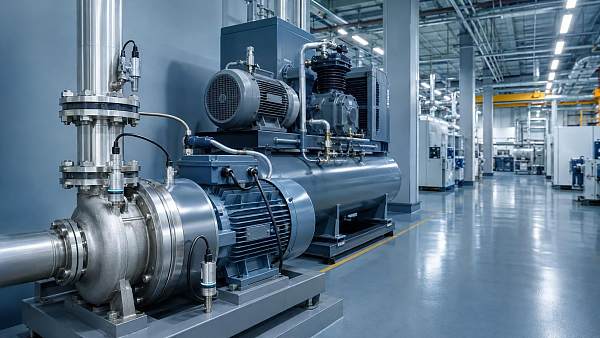
That shift matters across process industries, utilities, water treatment, chemicals, food production, and heavy manufacturing. In these settings, pumps, valves, compressors, and separation systems shape uptime, emissions, utility spend, and production stability at the same time.
For that reason, industrial machinery trends 2026 are less about isolated equipment upgrades and more about system-level performance. The strongest signals now come from energy efficiency, digital visibility, lifecycle reliability, and clearer ROI discipline.
Why 2026 Looks Different
The market is moving beyond simple replacement cycles. Facilities are being pushed by stricter motor efficiency rules, carbon reporting pressure, water reuse targets, and rising concern over supply chain exposure for critical components and metals.
At the same time, the economics have changed. Electricity, compressed air losses, fluid leakage, unplanned downtime, and maintenance labor now carry a larger share of operating cost than many investment models captured a few years ago.
This is where industrial machinery trends 2026 become practical. The winning projects will usually be the ones that connect technical performance with finance language: lower specific energy use, fewer stoppages, longer service intervals, and stronger production continuity.
From Standalone Machines to Performance Networks
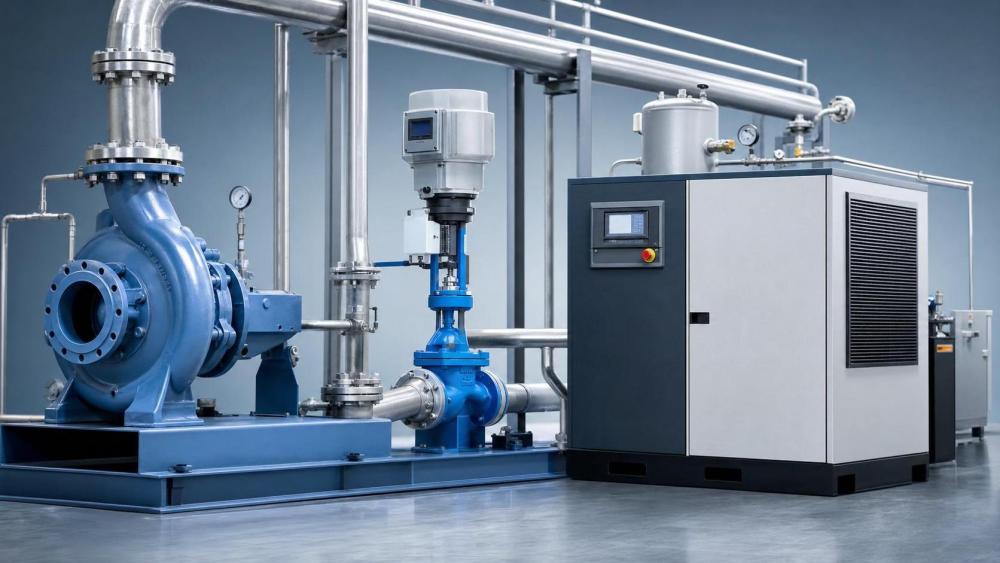
A useful way to read industrial machinery trends 2026 is to treat machinery as an interdependent network. Fluid and gas systems do not create value through one component alone. They succeed through balance across pumping, control, compression, and separation.
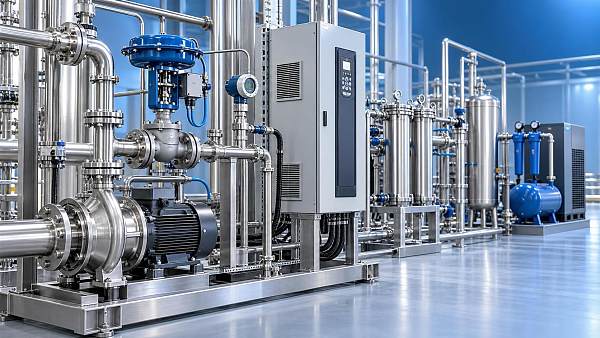
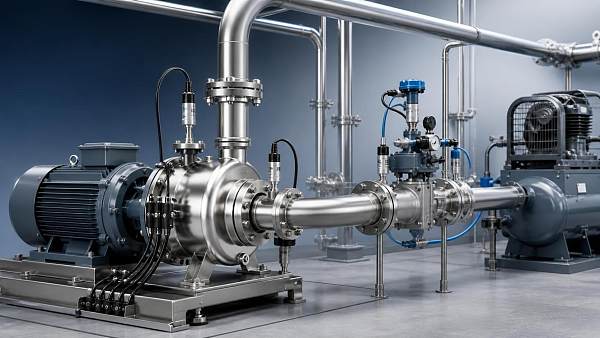
In process operations, centrifugal pumps act as the circulation core. Their efficiency curve, cavitation resistance, seal design, and material choice directly affect energy draw, maintenance frequency, and product safety.
High-pressure plunger pumps matter where extreme pressure defines output, such as SWRO and demanding extraction environments. Here, volumetric efficiency and durability under severe load can determine whether a project remains economically viable.
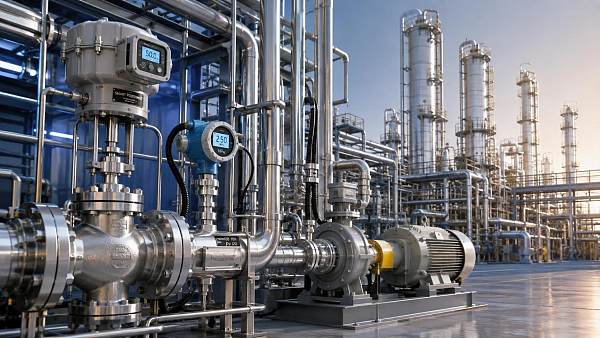
Smart pneumatic control valves are increasingly judged by controllability, response speed, noise behavior, and digital position feedback. A valve is no longer only a flow restriction device. It is part of the plant’s data and stability architecture.
Air compressor systems remain one of the most visible efficiency battlegrounds. Permanent magnet variable frequency designs and two-stage compression are gaining traction because compressed air waste is easier to measure and easier to monetize.
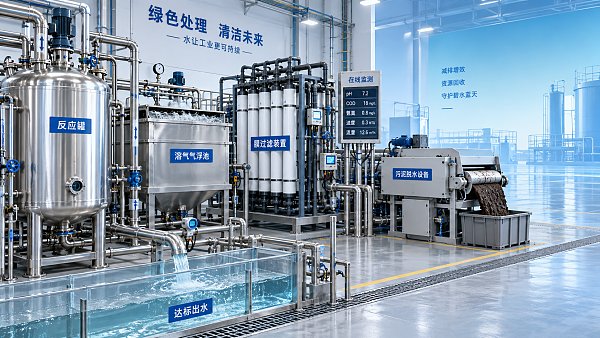
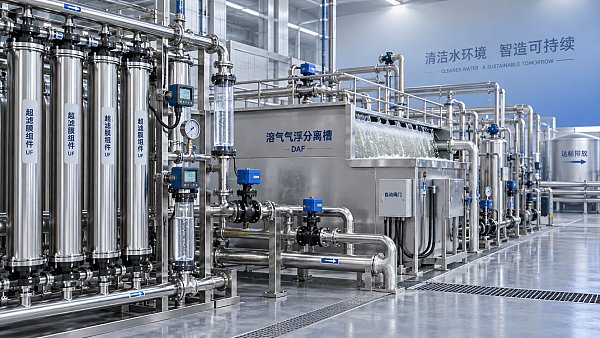
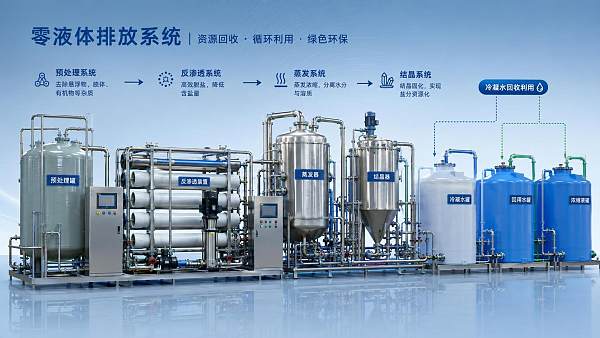
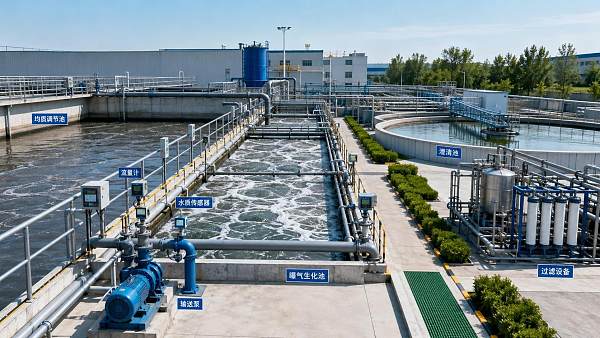
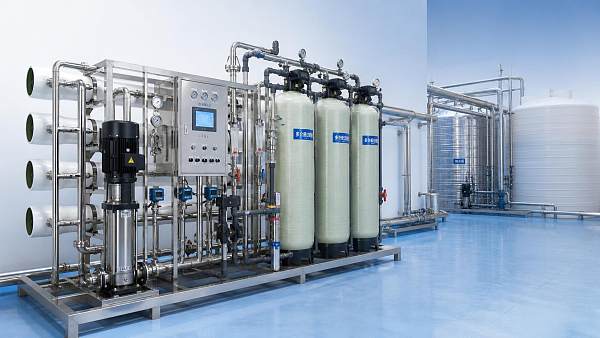
Filtration and separation systems are moving into a strategic role as water stress, discharge rules, and ZLD ambitions rise. Their value now extends beyond compliance into reuse economics, asset protection, and wider ESG credibility.
The Strongest Signals Inside Industrial Machinery Trends 2026
Several themes are appearing consistently across machinery investment decisions. They are technical trends, but they are also signals about what buyers will reward and what assets will struggle to justify themselves.
Energy efficiency is becoming a market filter
Efficiency claims are no longer persuasive without context. Buyers increasingly ask for duty-point performance, part-load behavior, annualized energy models, and evidence under real operating conditions rather than ideal benchmarks.
This is especially relevant for pumps and compressors, where even small performance improvements can scale into major annual savings. In 2026, energy-efficient machinery will not be a premium story alone. It will be a qualification threshold.
Automation is shifting from control to prediction
Industrial machinery trends 2026 point toward smarter diagnostics, not just more sensors. Plants want clearer indications of cavitation onset, valve instability, compressor load mismatch, membrane fouling, and bearing degradation before they disrupt output.
That makes high-quality signal interpretation more valuable than raw connectivity. Data without decision value creates dashboard noise. Data tied to maintenance timing, energy deviation, and process correction creates operational leverage.
ROI scrutiny is becoming more exact
Many capital teams now compare projects through payback windows, avoided downtime, utility savings, emissions impact, and risk reduction together. This benefits machinery categories where hidden losses were historically accepted as normal.
Compressed air leaks, pump oversizing, unstable flow control, and poor filtration stages are classic examples. They often look manageable in daily operations while quietly eroding margin every hour.
Where These Trends Show Up First
The broad theme is global, but the urgency differs by operating environment. The table below captures where industrial machinery trends 2026 are likely to appear first and why they matter.
Across these cases, the pattern is consistent. Investment is moving toward machinery that can prove efficiency, preserve process stability, and generate trustworthy operational data.
Why Better Intelligence Matters More Than More Data
One challenge in reading industrial machinery trends 2026 is separating noise from durable change. Markets are full of digital claims, efficiency labels, and broad decarbonization messaging, but not all of them translate into real operating advantage.
This is why specialized intelligence platforms have gained importance. FCSM, for example, frames machinery through fluid dynamics, thermodynamic behavior, lifecycle reliability, and global commercial pressure rather than through product catalog language alone.
That perspective is useful because machinery decisions are becoming more technical, not less. Cavitation modeling, valve noise under critical flow velocity, screw compressor rotor evolution, and material shocks in the supply chain all affect project outcomes.
In practice, this means better decisions come from connecting engineering detail with business consequence. A small hydraulic mismatch can become a large energy penalty. A modest control instability can become a major quality and maintenance issue.
How to Read ROI in 2026 Without Oversimplifying It
A narrow payback model can miss the real value of machinery upgrades. Industrial machinery trends 2026 suggest using a wider ROI frame that includes direct and indirect effects across the asset lifecycle.
- Measure energy use at the actual duty point, not the nameplate ideal.
- Account for downtime avoidance and maintenance interval extension.
- Include process quality, leakage control, and utility waste reduction.
- Test whether digital features improve action speed, not only data volume.
- Check spare parts risk and material availability for long-life assets.
Usually, the strongest cases are not based on a single saving line. They come from stacked benefits: lower electricity use, fewer interventions, better compliance, and less production disruption.
Practical Priorities for the Next Review Cycle
For anyone tracking industrial machinery trends 2026, the next step is not to chase every emerging feature. It is to identify where system inefficiency, control weakness, or reliability risk is already visible and economically meaningful.
A useful starting point is to review the assets that consume the most energy, trigger the most maintenance hours, or sit closest to regulatory exposure. In many operations, that quickly points back to pumps, compressors, valves, and separation stages.
After that, compare upgrade options through three questions. Does the change improve whole-system performance? Can the gain be measured clearly? Will the result still matter under tighter carbon, water, and reliability expectations?
Industrial machinery trends 2026 are ultimately pointing toward disciplined modernization. The better path is to build a shortlist based on energy intensity, automation usefulness, and ROI credibility, then test each option against real operating conditions and long-term resilience.
- high-pressure plunger pumps
- smart pneumatic control valves
- air compressor systems
- centrifugal pumps
- plunger pumps
- control valves
- pneumatic control valves
- air compressors
- fluid dynamics
- energy efficiency
- two-stage compression
- decarbonization
- industrial machinery trends
- industrial machinery
- industrial machinery trends 2026
Related News
 What drives industrial wastewater treatment cost per cubic meter?Dr. Alistair VaughnIndustrial wastewater treatment cost per cubic meter depends on influent load, effluent targets, energy, technology, and sludge disposal. Explore the key cost drivers.
 How to verify CE compliance for fluid separation equipmentDr. Alistair VaughnFluid separation equipment CE verification made practical: learn how to check declarations, risk assessments, technical files, pressure safety, and installation readiness.
 Separation equipment trends reshaping industrial wastewater treatmentDr. Alistair VaughnSeparation equipment trends are reshaping industrial wastewater treatment through smarter membranes, modular systems, digital monitoring, and resource recovery strategies.
 When stainless steel separation equipment is the right choice for hygienic processesDr. Alistair VaughnStainless steel separation equipment: discover when hygienic design, corrosion resistance, CIP cleanability, and lifecycle reliability make it the smart choice.
 What to assess before choosing a process industry automation supplierDr. Alistair VaughnChoose a process industry automation supplier with confidence. Assess engineering depth, lifecycle reliability, digital integration, energy performance, and safety before you buy.
 How process control innovation in refineries reduces unplanned shutdownsDr. Alistair VaughnDiscover how process control innovation in refineries detects early deviations, improves valve and equipment reliability, and helps prevent costly unplanned shutdowns.
 What should a zero liquid discharge systems integrator include in its proposal?Dr. Alistair VaughnZero liquid discharge systems integrator proposal checklist: compare guarantees, utilities, scope, controls, waste handling, and lifecycle risk before award.
 Industrial wastewater treatment plant design: sizing for flow and loadDr. Alistair VaughnIndustrial wastewater treatment plant design guide: size systems for peak flow, pollutant loads, reliability, compliance, and lower lifecycle costs.
 Can predictive maintenance and machinery diagnostics prevent downtime?Dr. Alistair VaughnPredictive maintenance machinery diagnostics help reduce unplanned downtime by detecting early equipment issues, improving reliability, and enabling smarter maintenance decisions.
 Can a digital transformation machinery platform cut unplanned downtime?Dr. Alistair VaughnDiscover how a digital transformation machinery platform connects asset data, maintenance workflows, and process insights to reduce unplanned downtime.
 How water treatment equipment sizing affects operating costsDr. Alistair VaughnWater treatment equipment sizing shapes energy, chemical, and maintenance costs. Learn how to balance flow, pressure, recovery, and reliability for efficient operation.
 When does food processing automation justify the upfront investment?Dr. Alistair VaughnIndustrial automation solutions for food processing: discover when automation delivers measurable ROI through higher throughput, lower waste, reliable utilities, and stronger food safety control.