Predictive Maintenance Machinery Diagnostics: 7 Signals Before Failure




Why does predictive maintenance machinery diagnostics matter before a failure is visible?
Predictive maintenance machinery diagnostics is valuable because most failures do not begin with a dramatic stop. They begin with small, measurable changes.
In pumps, compressors, valves, and separation equipment, those changes often appear days or weeks before a shutdown.
That is why field teams increasingly rely on predictive maintenance machinery diagnostics instead of waiting for alarms, leaks, or seized components.
The practical goal is simple. Catch the signal early, confirm the fault path, and schedule service before production is forced to stop.
This matters even more in general machinery environments linked to fluid transport and compressed air stability.
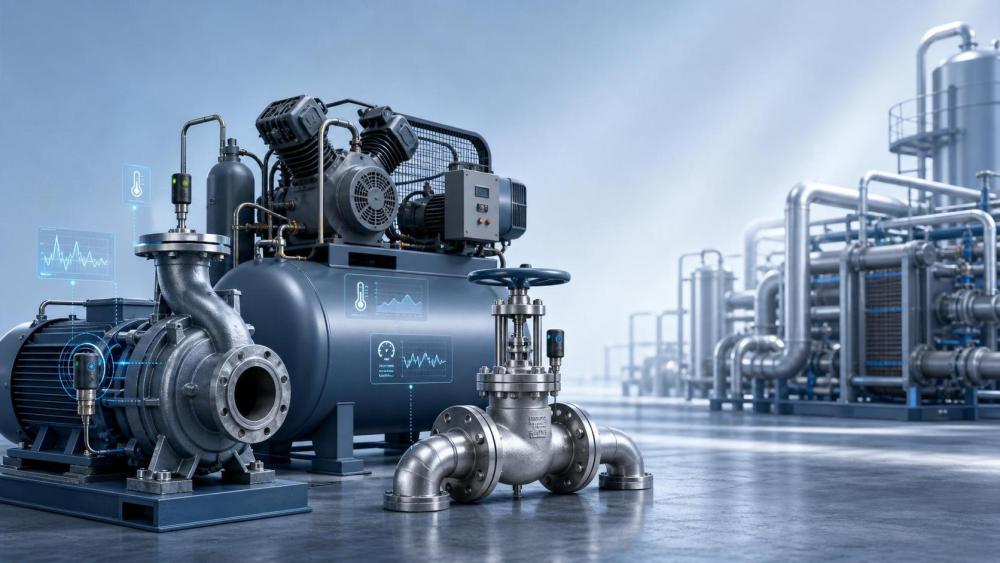
A centrifugal pump with rising vibration, a control valve with unstable positioning, or a compressor with abnormal thermal drift can all trigger larger system losses.
FCSM tracks these patterns across industrial pump sets, smart valves, air compressor systems, and filtration lines because reliability now connects directly to energy efficiency and decarbonization targets.
In daily service work, the most useful approach is not chasing every anomaly. It is building a short list of warning signals that consistently appear before failure.
Which seven signals usually show up first in predictive maintenance machinery diagnostics?
The earliest warnings are rarely identical across all equipment, but seven signals appear again and again in field diagnostics.
They work best when reviewed together rather than in isolation.
- Vibration pattern shifts, especially at bearing, coupling, and impeller frequencies.
- Temperature drift in bearings, motor windings, discharge zones, or valve actuators.
- Pressure instability, including pulsation, pressure loss, or uneven differential pressure.
- Flow deviation from baseline, even when operators report normal output.
- Power and current changes that suggest overload, friction, or efficiency decay.
- Lubricant condition changes, such as particle count, viscosity loss, or moisture ingress.
- Acoustic anomalies, including cavitation noise, valve chatter, and compressor knock.
For example, a pump can still run while cavitation starts. The first clue may be noise and vibration, not flow collapse.
A compressor may hold pressure while motor current and discharge temperature slowly increase. That often points to internal wear or cooling problems.
A control valve can still move on command while its positioner hunts. In practice, that instability often appears before serious trim damage.
A quick field reference for the seven signals
The table below is useful when deciding whether a signal deserves immediate inspection or trend monitoring.
How do these warning signs differ across pumps, compressors, valves, and separation systems?
This is where predictive maintenance machinery diagnostics becomes more than a checklist. The same signal means different things on different assets.
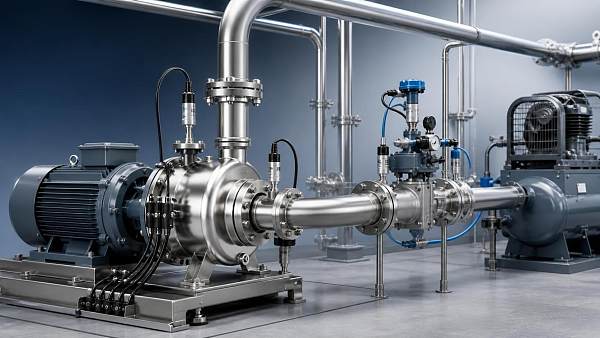
On centrifugal pumps, vibration and acoustics often lead the story. Cavitation, recirculation, and seal degradation can start quietly, then accelerate fast.
On high-pressure plunger pumps, pressure pulsation is usually more sensitive. Small valve wear or plunger seal damage can quickly create efficiency loss.
Air compressor systems tend to reveal problems through thermal behavior, current draw, and pressure recovery time.
If discharge temperature rises while output stays flat, internal leakage or cooling deterioration should be suspected.
Smart pneumatic control valves often show trouble through position instability, excessive air consumption, and noise near critical flow velocity.
In industrial filtration and separation, the signal usually appears as differential pressure growth, flow loss, or shortened cleaning cycles.
FCSM regularly connects these machine symptoms with fluid dynamic behavior, because raw sensor alarms alone rarely explain root cause.
That broader view is especially useful when maintenance teams must decide whether the fault is mechanical, process-driven, or both.
What usually gets misread during predictive maintenance machinery diagnostics?
A common mistake is treating one abnormal number as proof of failure. In reality, one signal is often only a clue.
Another mistake is comparing data from unstable operating conditions. A pump at partial load will not behave like the same pump near best efficiency point.
The same problem appears in valves and compressors. Process changes can mimic equipment faults if baseline conditions are not documented.
More subtly, teams sometimes replace parts too early because trend direction was ignored. A high value that stays stable may be less urgent than a smaller value rising quickly.
It also helps to separate symptom from cause. Noise at a valve may be a trim issue, but it may also come from upstream pressure instability.
- Do not judge vibration without speed, load, and mounting context.
- Do not dismiss a temperature rise just because production remains normal.
- Do not sample oil after topping up or mixing brands.
- Do not trust a single pressure instrument without cross-checking calibration.
- Do not treat predictive maintenance machinery diagnostics as a software report alone.
The stronger method is layered verification. Match sensor trend, operating condition, inspection evidence, and known failure history.
How often should diagnostics be reviewed, and what is worth measuring first?
Review frequency depends on criticality, duty cycle, and failure consequence, not just machine type.
A standby pump in clean service can be trended differently from a continuously loaded compressor in a hot environment.
In actual field use, the best starting point is a short measurement set that is repeatable.
For many assets, that means vibration, temperature, pressure, power, and one process indicator such as flow or cycle stability.
If lubrication is critical, oil analysis should be added early. If cavitation or valve noise is common, acoustic recording becomes more useful.
A practical review rhythm often looks like this:
- Daily trend scan for critical assets with live monitoring.
- Weekly comparison for machines with moderate process impact.
- Monthly route-based checks for stable or redundant equipment.
- Event-based review after overhaul, process change, or seal replacement.
Predictive maintenance machinery diagnostics works best when the baseline is refreshed after major maintenance. Otherwise, teams keep comparing against old machine behavior.
What is the most practical way to act on diagnostic results without overreacting?
The most effective response is to rank findings by failure risk, production consequence, and time to intervene.
Not every anomaly needs an immediate shutdown. Some need closer monitoring. Others need a controlled outage plan.
A useful decision rule is to ask three questions. Is the signal worsening, is efficiency dropping, and is secondary damage likely?
If all three are true, action should move quickly. That is especially true for bearing distress, cavitation erosion, actuator hunting, and thermal overload.
Where FCSM adds value is in linking diagnostic evidence with broader machinery intelligence, including CFD-related cavitation patterns, valve noise behavior, and compressor thermodynamic drift.
That makes the next step clearer. Service decisions stop being reactive guesses and become evidence-based maintenance choices.
To move forward, start with one asset family, define the seven signal baselines, and review trend quality before adding more sensors.
Then build a simple rule set for inspection, repair planning, and post-maintenance verification. That is how predictive maintenance machinery diagnostics becomes a working routine instead of a missed opportunity.
- high-pressure plunger pumps
- smart pneumatic control valves
- air compressor systems
- industrial pump sets
- predictive maintenance machinery
- centrifugal pumps
- plunger pumps
- control valves
- pneumatic control valves
- separation equipment
- industrial filtration
- predictive maintenance
- energy efficiency
- decarbonization
- predictive maintenance machinery diagnostics
Related News
 What drives industrial wastewater treatment cost per cubic meter?Dr. Alistair VaughnIndustrial wastewater treatment cost per cubic meter depends on influent load, effluent targets, energy, technology, and sludge disposal. Explore the key cost drivers.
 How to verify CE compliance for fluid separation equipmentDr. Alistair VaughnFluid separation equipment CE verification made practical: learn how to check declarations, risk assessments, technical files, pressure safety, and installation readiness.
 Separation equipment trends reshaping industrial wastewater treatmentDr. Alistair VaughnSeparation equipment trends are reshaping industrial wastewater treatment through smarter membranes, modular systems, digital monitoring, and resource recovery strategies.
 When stainless steel separation equipment is the right choice for hygienic processesDr. Alistair VaughnStainless steel separation equipment: discover when hygienic design, corrosion resistance, CIP cleanability, and lifecycle reliability make it the smart choice.
 What to assess before choosing a process industry automation supplierDr. Alistair VaughnChoose a process industry automation supplier with confidence. Assess engineering depth, lifecycle reliability, digital integration, energy performance, and safety before you buy.
 How process control innovation in refineries reduces unplanned shutdownsDr. Alistair VaughnDiscover how process control innovation in refineries detects early deviations, improves valve and equipment reliability, and helps prevent costly unplanned shutdowns.
 What should a zero liquid discharge systems integrator include in its proposal?Dr. Alistair VaughnZero liquid discharge systems integrator proposal checklist: compare guarantees, utilities, scope, controls, waste handling, and lifecycle risk before award.
 Industrial wastewater treatment plant design: sizing for flow and loadDr. Alistair VaughnIndustrial wastewater treatment plant design guide: size systems for peak flow, pollutant loads, reliability, compliance, and lower lifecycle costs.
 Can predictive maintenance and machinery diagnostics prevent downtime?Dr. Alistair VaughnPredictive maintenance machinery diagnostics help reduce unplanned downtime by detecting early equipment issues, improving reliability, and enabling smarter maintenance decisions.
 Can a digital transformation machinery platform cut unplanned downtime?Dr. Alistair VaughnDiscover how a digital transformation machinery platform connects asset data, maintenance workflows, and process insights to reduce unplanned downtime.
 How water treatment equipment sizing affects operating costsDr. Alistair VaughnWater treatment equipment sizing shapes energy, chemical, and maintenance costs. Learn how to balance flow, pressure, recovery, and reliability for efficient operation.
 When does food processing automation justify the upfront investment?Dr. Alistair VaughnIndustrial automation solutions for food processing: discover when automation delivers measurable ROI through higher throughput, lower waste, reliable utilities, and stronger food safety control.