What drives separation equipment price differences between suppliers?




A separation system can look comparable on two quotations: similar throughput, similar vessel size, and the same broad label of “filter,” “separator,” or “membrane skid.” Yet the quoted amount may differ sharply. The gap is rarely explained by supplier margin alone. In industrial service, separation equipment price differences usually come from what is included in the duty definition, wetted materials, separation performance, controls, fabrication quality, testing, documentation, and support after delivery.
The practical decision is not to ask which supplier is cheapest. Ask whether each supplier is pricing the same operating responsibility. A lower quote may be appropriate for clean, stable feed and non-critical service. It becomes risky when the equipment must handle abrasive slurry, corrosive liquid, variable solids loading, difficult emulsions, high temperature, or a discharge requirement that leaves little room for performance drift. Normalize the scope before comparing totals; otherwise, a low capital cost can conceal a costly operating burden.
Start by checking whether the process duty is truly the same
Suppliers may receive the same basic request but make different assumptions about the feed. One may size a unit for average flow, while another designs for peak flow or a fouling allowance. One may assume settled solids; another may account for fibrous matter, oil carryover, temperature variation, or intermittent chemical cleaning. These assumptions change filter area, residence time, pump duty, membrane flux, media volume, vessel size, and installed motor power.
Before treating a price difference as commercial, compare the underlying design basis line by line:
- Minimum, normal, and maximum flow rate
- Feed composition, solids concentration, particle-size range, viscosity, and temperature
- Required filtrate, permeate, concentrate, or cake quality
- Expected operating hours, batch frequency, and allowable downtime
- Pressure, vacuum, and temperature limits at the actual installation point
- Cleaning method, chemical compatibility, and waste handling requirements
- Whether the quoted capacity is initial capacity or sustained capacity as fouling develops
A centrifugal separator designed around nominal flow may cost less than one with sufficient margin for feed surges. A membrane package offered at a high initial flux can appear economical, but the comparison changes if the competing design uses more membrane area to maintain output as the feed becomes fouled. Neither approach is automatically wrong. The issue is whether the supplier has stated the basis clearly enough for the buyer to judge operating risk.
Separation accuracy has a real hardware cost
Removing large suspended solids from utility water is not equivalent to producing low-turbidity process water, breaking a stable oil-water emulsion, polishing compressed-air condensate, or concentrating fine sludge. Tighter separation targets often require finer media, additional stages, lower loading rates, better flow distribution, or more sophisticated instrumentation.
For filtration equipment, price can move with nominal versus absolute rating, media structure, cartridge configuration, and the ability to avoid channeling or bypass. In membrane systems, membrane chemistry, feed spacer design, pressure-rated housings, recovery target, pretreatment needs, and cleaning provisions all matter. A basic screen or basket strainer may be sufficient where large debris is the only concern, but it should not be compared economically with a self-cleaning filter expected to protect sensitive downstream equipment continuously.
Buyers should also examine the wording used for performance claims. “Removal down to” a given particle size is not the same as a guaranteed retention level under the stated feed conditions. Likewise, a quoted flow is incomplete without a pressure-drop limit, viscosity range, solids loading, and cleaning interval. The more precisely the supplier defines performance boundaries, the easier it is to understand why the offer is priced as it is.
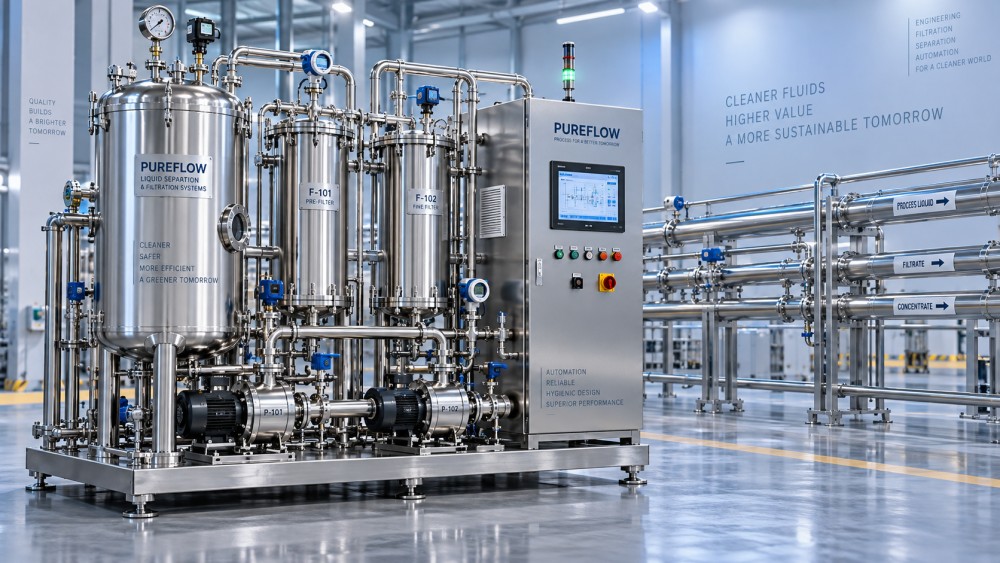
Material selection is often the largest visible cost difference
Two systems with nearly identical drawings can differ substantially because of the material in contact with the process fluid. Carbon steel may be appropriate for certain non-corrosive duties. Stainless steel, duplex alloys, high-alloy materials, rubber lining, engineered polymers, fluoropolymer linings, or specialty elastomers may be necessary where chlorides, acids, solvents, oxidants, high temperature, or abrasive media are present.
The material question goes beyond the main vessel. Cost also changes with valve bodies, pump wetted ends, fasteners, piping, gaskets, seals, instrument wetted parts, filter housings, and membrane housings. A quote that specifies a corrosion-resistant vessel but uses less suitable auxiliaries can look competitive while shifting failure exposure to fittings, valves, or seals.
Material upgrades should be tied to a credible corrosion, temperature, or compatibility requirement rather than selected by habit. At the same time, reducing material specification without checking the entire chemical environment can create a short-lived saving. Consider cleaning fluids, off-spec process conditions, stagnant periods, and any possibility of mixed contaminants, not merely the normal feed specification.
Automation can make a low quote expensive to operate
A manually operated unit generally has a lower initial price than an automated skid. That does not mean manual operation is inferior. It may be the sensible choice for a small batch process, a standby duty, or a system attended by operators during each cycle. The cost equation changes where differential pressure rises quickly, backwashing must occur at repeatable intervals, liquid levels fluctuate, or an unattended system must protect downstream pumps, membranes, or valves.
Automation scope varies widely between suppliers. One offer may include only a local start-stop control. Another may include pressure transmitters, flow measurement, turbidity or conductivity monitoring, automatic backwash valves, sequencing logic, alarms, remote status points, a variable-frequency drive, and integration-ready communications. These are not interchangeable scopes, even if both are described as “automatic.”
When comparing controls, identify the function behind each component. A differential-pressure transmitter can initiate cleaning before flow collapses. A conductivity instrument may indicate membrane breakthrough or rinse completion. Flow measurement can expose declining production before it becomes a process interruption. Conversely, not every instrument improves the outcome; instrumentation that cannot be maintained or calibrated at the site can add complexity without creating useful control.
Fabrication quality is not always obvious from the equipment list
Separation equipment is often judged by its major components, but fabrication detail influences leakage risk, cleanability, vibration behavior, service access, and repeatability. The difference can include weld procedures, internal alignment, pipe support, drainability, access covers, lifting provisions, skid rigidity, electrical enclosure selection, cable management, and whether valves and instruments can be reached safely.
These details matter most when the process cannot tolerate contamination, unplanned shutdowns, or difficult maintenance. A poorly located isolation valve may turn a routine cartridge change into a partial shutdown. Insufficient drain points can complicate chemical cleaning. Inadequate access around a centrifuge or filter housing can add labor every time an internal component must be inspected.
Instead of relying on general statements about workmanship, request a general arrangement drawing, process and instrumentation diagram where applicable, component list, and a clear battery-limit definition. Review which connections are supplied, which are only indicated, and whether interconnecting pipework, electrical cabling, foundations, drains, and vent routing are excluded. Apparent price gaps often emerge from these boundary differences.
Testing, documentation, and compliance scope affect the quotation
Some separation packages are supplied as standard catalog equipment. Others require material traceability, pressure testing, factory acceptance checks, weld records, electrical documentation, operating manuals, spare-parts lists, performance verification, or third-party inspection coordination. These activities consume engineering time and may require additional controls during manufacturing.
The right level of documentation depends on the consequences of failure and the project’s internal requirements. A simple utility-water filter may not need the same document package as equipment handling hazardous, regulated, or high-purity process streams. The problem arises when one supplier includes required documentation and test scope while another excludes it or lists it as an option. The headline prices then do not represent equivalent deliverables.
Ask each supplier to separate included tests from optional tests. For performance-related equipment, define what can realistically be tested at the factory and what must be confirmed after installation with actual feed. A supplier should not be expected to guarantee performance against an unknown feed condition, but the offer should state the assumptions, acceptance basis, and any limitation that affects responsibility.
Energy and consumables can outweigh an initial purchase saving
The lowest equipment price can be attractive when capital approval is tight, yet separation processes frequently carry continuing costs through pump energy, compressed air, filter cartridges, media replacement, membranes, chemicals, wash water, disposal, and labor. A modest difference in pressure drop, recovery, cleaning frequency, or solids handling can change the operating profile over the equipment’s useful life.
Compare the offers using a common operating scenario rather than a vague lifecycle claim. Request the following information where relevant:
- Installed and normal absorbed power, not only motor nameplate size
- Expected pressure drop at clean and dirty conditions
- Cleaning, backwash, regeneration, or chemical-cleaning frequency assumptions
- Consumable type, expected replacement trigger, and quantity per changeout
- Water loss, reject volume, sludge volume, or product loss associated with separation
- Routine maintenance tasks and components that normally require replacement
These figures should be treated as design assumptions, not universal promises. Feed quality and operating discipline strongly influence them. Still, the exercise reveals whether a lower-priced design relies on frequent manual intervention, higher pumping pressure, or consumables that were not visible in the purchase order.
After-sales scope changes the risk allocation
Commissioning assistance, operator training, troubleshooting support, spare-parts availability, and response arrangements are frequently priced differently. A supplier that provides only delivered equipment is taking on less responsibility than one that supports startup, reviews operating data, and helps establish cleaning or maintenance routines.
Support is particularly important for membrane separation, centrifuges, automatic filtration systems, and processes with variable feed. The first months of operation may reveal that the feed differs from laboratory assumptions or that cleaning needs adjustment. This does not automatically indicate faulty equipment, but it requires competent diagnosis: is the issue fouling, incorrect chemistry, a hydraulic restriction, excess solids loading, instrument error, or an unsuitable operating sequence?
Rather than treating support as a vague service promise, define the practical items that matter: startup attendance or remote support, training scope, recommended commissioning spares, documentation format, normal wear parts, and the route for obtaining technical answers after handover.
A workable way to compare supplier quotations
Build a comparison sheet that separates the quoted purchase amount from scope differences. Do not begin with a weighted scoring model before the technical baseline is aligned; a detailed score can create false precision when one supplier has quoted a different system entirely.
- Freeze the duty statement. Record flow range, feed contaminants, quality target, operating schedule, utilities, and constraints.
- Map each offer against that duty. Mark assumptions, exclusions, and deviations in plain language.
- Separate mandatory items from options. Add required instruments, connections, tests, commissioning, and spares to each comparable scope.
- Review operating exposures. Focus on pressure drop, energy, consumables, cleaning demand, waste streams, and operator time.
- Challenge ambiguous capacity claims. Ask whether capacity is based on clean conditions, normal conditions, or end-of-run conditions.
- Assess consequence of underperformance. The greater the production, quality, safety, or environmental consequence, the more valuable clear guarantees, robust materials, and support become.
A supplier with the higher separation equipment price may be offering more conservative sizing, more durable materials, a fuller automation package, or a wider execution scope. A lower-cost supplier may still be the better fit where the duty is simple and the exclusions are acceptable. The defensible choice comes from making those differences visible before the order is placed, rather than discovering them during installation, commissioning, or the first difficult feed condition.
Facing technical bottlenecks in manufacturing or looking for more efficient industrial solutions? Leave your details below and let the engineering experts at FCSM solve them for you.
Related News
 Beijing Plan Calls for Higher Efficiency in Compressors, Pumps and Other EquipmentDr. Alistair VaughnBeijing's zero-carbon factory plan targets higher efficiency in compressors, pumps and other equipment. Explore what buyers and suppliers should verify.
 How does ISO 16889 measure hydraulic filter performance?Dr. Alistair VaughnIndustrial filtration and separation: discover how ISO 16889 measures hydraulic filter efficiency, beta ratios and contaminant capacity to help you compare filters with confidence.
 Sulzer and NABEP Agree to Support Rebuilding of Venezuelan Heavy-Oil UpgraderDr. Alistair VaughnSulzer and NABEP agree to support Venezuela’s Petrocedeño heavy-oil upgrader rebuild. Explore the supply-chain implications and key questions for suppliers.
 How to size control valves for boiler feedwaterDr. Alistair VaughnSize control valves for boiler feed with confidence. Learn to calculate Cv, assess low-load control, and prevent cavitation for reliable operation.
 How to detect leaks in industrial compressed air systemsDr. Alistair VaughnExplore compressed air system leak detection methods for industrial facilities. Find leaks safely, prioritize repairs, and verify results to reduce air loss.
 How to assess an industrial water treatment supplier's after-sales supportDr. Alistair VaughnAssess an industrial water treatment supplier’s after-sales support with practical checks for response times, technical expertise, spare parts and service costs.
 Selecting C20 Ductile Iron Pipe for Buried Water MainsDr. Alistair VaughnC20 ductile iron pipe selection starts with more than pressure class. Explore surge, soil, joint and approval checks to specify buried water mains with confidence.
 How industrial machinery retrofit trends are shaping energy efficiencyDr. Alistair VaughnExplore industrial machinery retrofit trends, from smart controls to system upgrades, and discover how to improve energy efficiency without compromising reliability.
 Gland Packing Market Forecast to Grow Through 2035 on Pump and Valve MaintenanceDr. Alistair VaughnGland packing market growth through 2035 is driven by pump and valve maintenance. Explore demand trends and opportunities in high-performance sealing.
 ComVac ASIA 2026 Opens in Shanghai, Focusing on Compressor IntelligenceDr. Alistair VaughnComVac ASIA 2026 opens in Shanghai, spotlighting intelligent compressors, digitalization and emerging opportunities in compressed air and vacuum technology.
 Industrial Compressor Overheating: Causes and Maintenance ChecksDr. Alistair VaughnIndustrial compressor selection starts with understanding overheating. Explore key causes, safety checks and maintenance tips to prevent recurring shutdowns.
 Industrial Compressor Sizing: Matching Capacity to DemandDr. Alistair VaughnMaster industrial compressor selection with practical guidance on sizing capacity, pressure, duty cycles and storage to meet demand efficiently.