New Maritime Code Shifts 'No-Take-Delivery' Liability to Exporters




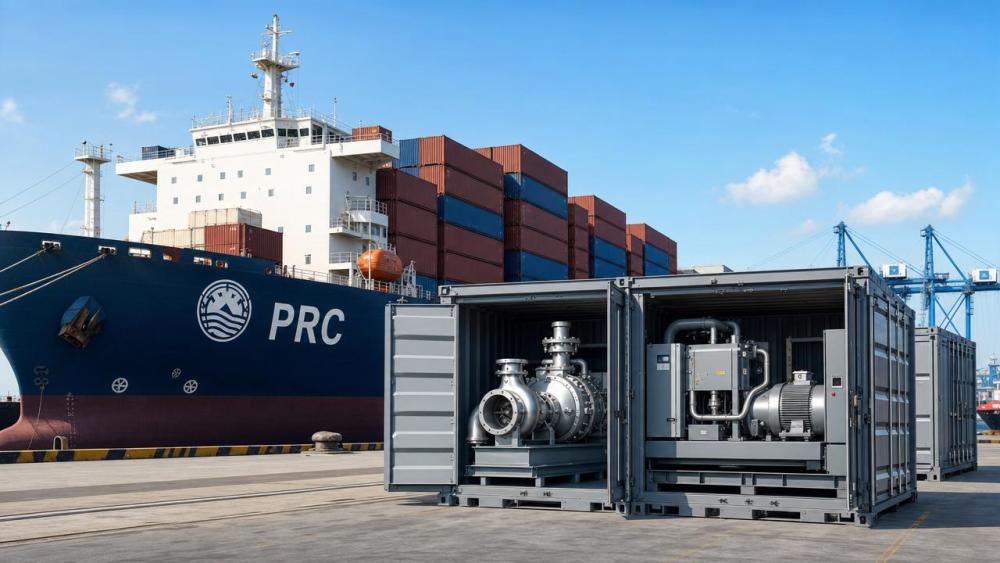
Effective 1 May 2026, the revised PRC Maritime Code — specifically Article 93 — reassigns primary legal and financial responsibility for unclaimed cargo at destination ports from consignees to shippers. This change directly impacts exporters of large industrial equipment, including centrifugal pumps and air compressors, increasing exposure to risks such as customs clearance delays and buyer abandonment.
Key Legal Change Effective 1 May 2026
As of 1 May 2026, Article 93 of the newly amended PRC Maritime Code establishes shipper-first liability for cargo remaining uncollected at the discharge port. Previously, responsibility rested primarily with the consignee. The amendment applies uniformly across international maritime shipments originating from mainland China and takes immediate effect upon implementation.
Impact Across Supply Chain Roles
Direct Trading Enterprises
Export-oriented trading firms now bear heightened legal accountability if imported goods are not collected. This affects contract negotiation, risk allocation in Incoterms® clauses (especially FOB and CIF), and post-shipment monitoring obligations — particularly for high-value, bulky items like centrifugal pumps and air compressors where storage and demurrage costs escalate rapidly.
Manufacturing Enterprises
Equipment manufacturers acting as exporters must reassess delivery terms, documentation workflows, and contractual safeguards. Delays in overseas customs clearance or buyer insolvency no longer insulate them from port charges, disposal liabilities, or potential claims arising from abandoned cargo.
Supply Chain Service Providers
Freight forwarders, customs brokers, and overseas warehousing agents face intensified coordination demands. Shippers increasingly require real-time visibility into consignee readiness, import license status, and local regulatory compliance — making agent reliability and responsiveness critical operational factors.
Critical Actions for Exporters
Review and Amend Trade Terms
Immediate revision of sales contracts and pro forma invoices is required to reflect updated risk allocation. Preference should shift toward Incoterms® rules that clarify delivery completion (e.g., DAP or DPU) and explicitly define consignee obligations regarding timely pickup and customs release.
Secure Specialized Cargo Liability Insurance
Standard marine cargo insurance typically excludes liabilities arising from uncollected goods. Exporters must procure supplementary freight liability coverage addressing port storage fees, demurrage, detention, and disposal costs triggered by non-take-delivery scenarios.
Strengthen Overseas Agent Governance
Proactive engagement with trusted local partners — including verification of their capacity to manage cargo release, customs coordination, and contingency disposal — is now a core compliance requirement, not merely an operational convenience.
Industry Perspective: A Structural Shift in Risk Allocation
Analysis shows this amendment reflects a broader trend toward strengthening upstream accountability in cross-border logistics. From an industry perspective, it incentivizes more rigorous pre-shipment due diligence — such as verifying importer solvency, import licensing status, and local regulatory capacity — rather than relying solely on post-shipment documentation. What deserves closer attention is how quickly global freight insurers adapt policy wording and premium structures to cover newly assigned shipper liabilities, especially for capital goods with long lead times and complex import procedures.
Strategic Implications for Industrial Equipment Exporters
This regulatory update marks a material recalibration of export risk management — moving beyond traditional concerns like product conformity or shipping documentation to encompass end-to-end delivery assurance. It does not eliminate market opportunities, but it does raise the operational and contractual threshold for sustainable participation in international trade. Success will depend less on volume and more on integrated risk governance spanning legal, insurance, logistics, and commercial functions.
Source Information and Verification Notes
This article is generated exclusively from the user-provided title, event date (2026-05-01), and summary. Specific official source links were not provided in the input and should be verified continuously. Stakeholders are advised to monitor subsequent guidance from China’s Ministry of Transport, Supreme People’s Court judicial interpretations, and updates to standard shipping documents issued by Chinese shipping associations. Further observation is warranted regarding implementation practices across major ports and evolving insurer underwriting criteria.
Related News
 When does self-cleaning filtration technology reduce maintenance downtime?Separation Tech FellowFiltration technology can reduce maintenance downtime when solids are predictable, cleaning is automated, and reject handling is reliable. Learn how to select the right system.
 How fluid control digitalization improves valve maintenance planningProcess Control ArchitectFluid control digitalization helps teams prioritize valve maintenance, reduce unplanned downtime, and improve reliability with actionable condition data.
 What drives industrial wastewater treatment cost per cubic meter?Dr. Alistair VaughnIndustrial wastewater treatment cost per cubic meter depends on influent load, effluent targets, energy, technology, and sludge disposal. Explore the key cost drivers.
 How to verify CE compliance for fluid separation equipmentDr. Alistair VaughnFluid separation equipment CE verification made practical: learn how to check declarations, risk assessments, technical files, pressure safety, and installation readiness.
 How smart valve positioners improve process control valve accuracyProcess Control ArchitectDiscover how smart positioners improve process control valve accuracy, reduce friction-related errors, enhance stability, and enable predictive maintenance.
 Motor energy efficiency comparison for variable-speed compressor selectionPneumatic Power StrategistMotor energy efficiency comparison for variable-speed compressor selection: compare package power, load profiles, controls, and lifecycle savings.
 How fluid dynamics analysis helps size a chemical process pumpFluid Dynamics ScientistFluid dynamics analysis helps engineers size chemical process pumps for reliable flow, NPSH margin, efficiency, and safer long-term operation.
 Separation equipment trends reshaping industrial wastewater treatmentDr. Alistair VaughnSeparation equipment trends are reshaping industrial wastewater treatment through smarter membranes, modular systems, digital monitoring, and resource recovery strategies.
 Which valve technology standards apply to pneumatic diaphragm valves?Process Control ArchitectValve technology standards for pneumatic diaphragm valves: explore design, testing, actuator safety, hygienic compliance, and specification guidance for reliable selection.
 When stainless steel separation equipment is the right choice for hygienic processesDr. Alistair VaughnStainless steel separation equipment: discover when hygienic design, corrosion resistance, CIP cleanability, and lifecycle reliability make it the smart choice.
 When ZLD fouling in RO membranes requires more than cleaningSeparation Tech FellowZLD fouling in RO membranes: learn when CIP is no longer enough, how to identify irreversible damage, and which process changes protect recovery and reduce replacement costs.
 What to verify before choosing a self cleaning filtration systems supplierSeparation Tech FellowChoose a self cleaning filtration systems supplier with confidence. Verify flow capacity, cleaning performance, materials, automation, support, and lifecycle value.