How to Prevent Pump Cavitation in Slurry Service




How to Prevent Pump Cavitation in Slurry Service
In slurry applications, pump cavitation slurry service issues can quickly erode performance, shorten equipment life, and raise maintenance costs. For technical evaluators, understanding how cavitation starts—and how system design, suction conditions, and operating control influence it—is essential to selecting reliable pumping solutions. This article outlines practical ways to prevent cavitation and improve stability in demanding slurry handling environments.
If you have ever looked at a slurry pump that lost head too early, sounded like it was moving gravel through the casing, and came back from inspection with pitted metal around the eye of the impeller, you already know the usual mistake: people treat cavitation like a simple pump problem. In slurry service, it is rarely that simple. Cavitation is usually a system problem with a pump-shaped symptom.
What follows is the checklist I would use before approving a pump selection, a retrofit, or a troubleshooting plan for abrasive duty.
Start with the slurry, not the pump curve
A surprising number of bad decisions start with water-based assumptions. Slurry changes suction behavior, wear rate, and operating margin. Before you discuss NPSH, ask for the solids concentration, particle size distribution, specific gravity, viscosity behavior if the slurry is non-Newtonian, operating temperature, and whether air entrainment is likely.
If those values are missing or based on an old design note, stop there. A pump that looks acceptable on a clean-water curve may have much less real margin in the field. For technical evaluation, this is a hard checkpoint: no validated slurry properties, no confident cavitation review.
Also check whether the process sees variation. Many systems cavitate only during startup, tank drawdown, winter temperature shifts, or when the solids content climbs above the nominal figure. Those are not edge cases. They are often the real operating cases.
Do not accept a thin NPSH margin
In slurry work, minimal suction margin is asking for trouble. The pump vendor will typically provide NPSHr based on water testing, commonly aligned with standard acceptance methods such as HI practice or test frameworks tied to ISO methods, but the field condition is harsher. Slurry, dissolved gas, entrained air, and wear all reduce your comfort zone.
The practical question is not “Does NPSHa exceed NPSHr on paper?” It is “How much margin remains after the site gets less ideal than the datasheet?” If the answer is barely any, expect noise, instability, and short life.
- Review NPSHa at the worst credible suction level, not the normal level.
- Use actual suction piping losses, including fittings, strainers, and fouling allowance where relevant.
- Check whether the vendor has slurry correction guidance or a recommended minimum margin for the duty.
- Treat air entrainment as a serious risk multiplier, especially in mining, tailings, dredging, and sump service.
If the procurement package only compares pumps by BEP efficiency and rated head, it is incomplete for slurry duty.
Look hard at the suction line layout
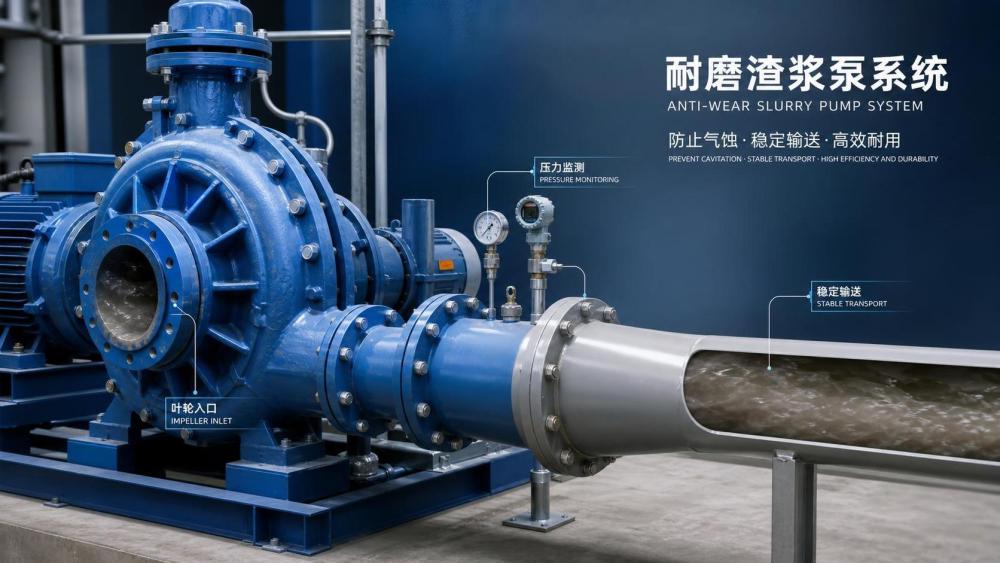
This is where many cavitation problems are quietly designed in. Long suction runs, undersized pipe, too many elbows near the pump nozzle, and poor reducer orientation all create velocity spikes and uneven flow into the impeller eye.
For slurry, the suction side has to do two things at once: avoid starving the pump and avoid settling solids. That balance is not always easy. Oversizing everything without checking solids suspension can create deposition zones. Undersizing to keep velocity up can push suction losses too high. You need both hydraulic and solids-handling discipline.
A few field checks matter more than elegant drawings:
- Confirm the suction pipe is not smaller than the pump inlet unless the manufacturer explicitly accepts it.
- Check for eccentric reducers installed flat-side up on horizontal suction lines, where appropriate, to avoid vapor pockets.
- Keep straight run into the pump where possible. Exact lengths depend on geometry and vendor guidance, so use project standards or manufacturer input rather than guesswork.
- Inspect the actual as-built routing. Site modifications after commissioning often explain why a once-stable pump starts cavitating.
Watch for air, because air and cavitation travel together
People sometimes describe a pump as cavitating when the bigger problem is air ingestion. In slurry systems, the distinction matters less than you might think because the damage path overlaps: unstable suction, loss of head, vibration, poor wear life.
Check the sump design, the submergence level, vortexing tendency, return flow location, and whether the process liberates gas. Flotation circuits, chemical slurries, and warm process streams can all complicate suction behavior. If bubbles are entering upstream, fixing only the pump selection may not solve anything.
A simple operator clue is valuable here: if noise and instability get worse as the tank level drops or as recirculation increases, suction-side air involvement is high on the suspect list.
Do not run far left or far right of the preferred operating range
Cavitation risk rises when a slurry pump is forced away from where it wants to run. Too far left of best efficiency point, internal recirculation becomes a real concern. Too far right, suction conditions may become insufficient. Either side can produce the sound technicians know immediately and procurement teams often hear about too late.
During technical evaluation, ask for the full expected operating envelope, not just the design point. Minimum flow, maximum flow, startup mode, flushing mode, upset mode. Then compare those conditions with the vendor’s preferred operating range guidance. If no one can show how the pump behaves across the envelope, you are not evaluating cavitation risk seriously enough.
Be careful with speed increases
Variable speed is useful, but it is not a free performance upgrade in slurry service. A modest RPM increase can sharply raise NPSHr and worsen wear. Teams sometimes push speed to recover lost head after wear or process drift, and that can turn a manageable pump into a cavitating one.
If speed control is part of the concept, ask for a cavitation review across the full speed range. That review should include suction margin, motor loading, solids handling, and wear implications. It is common sense, but it gets skipped.
Check impeller choice and wear allowance early
Impeller geometry matters. Large eye designs, inducer concepts in some services, lower-speed selections, or a larger pump running slower can all help depending on the duty. The right answer depends on the slurry and the operating target, so there is no universal rule. But there is one recurring error: selecting a pump that works only when new.
Slurry pumps wear. Clearances open up. Hydraulic performance shifts. If your cavitation margin disappears once the wet end is no longer fresh, the design is fragile. Ask vendors how performance changes over the wear cycle and whether the recommended maintenance intervals are based on similar slurry duty or on generic expectations. If the answer is vague, mark it for 【待核实】.
Do not confuse erosion with cavitation, but do expect them to combine
In slurry equipment, surface damage often has more than one cause. Abrasive wear, recirculation damage, and cavitation can overlap. If you misread the failure mode, you will fix the wrong thing. Cavitation usually leaves pitting or a hammered appearance in characteristic hydraulic zones, while pure abrasion often shows directional material loss. In practice, inspection should involve the pump specialist, operations, and whoever understands the slurry itself.
This matters during vendor comparison. A tougher alloy or elastomer can buy time, but it is not the primary cure for pump cavitation slurry service problems caused by poor NPSH margin or unstable suction flow.
Instrument the problem before you argue about it
If the site is already running and cavitation is suspected, get evidence. Suction pressure, discharge pressure, flow, tank level, density if available, motor load, vibration trend, and acoustic observations are more useful than a generic complaint that “the pump is noisy.”
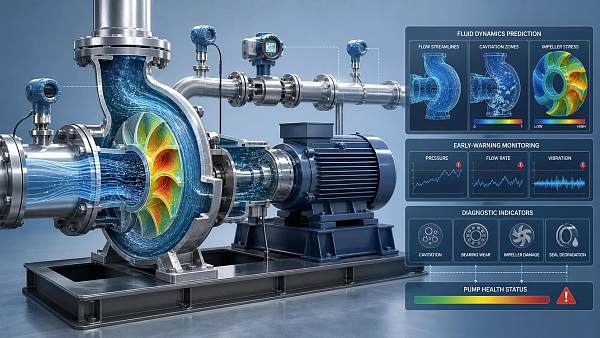
Trend the bad periods. Does the issue track low level, high throughput, warmer liquid, or a particular ore blend? In advanced sites, condition monitoring can help separate intermittent suction starvation from mechanical issues. You do not need a digital twin to do basic diagnosis well, but you do need data taken at the moment the problem occurs.
For new projects, review the system as a whole
The cleanest way to prevent cavitation is to stop designing for it. In practical terms, that means revisiting tank elevation, static head, suction piping, pump location, duty split, and control philosophy before equipment is frozen. Sometimes the right answer is not a different pump model but a lower installation, a flooded suction arrangement, a booster stage, or a revised operating strategy.
For critical duties, ask whether CFD or more detailed hydraulic review is justified. It is not necessary for every slurry line, but in high-value or failure-sensitive services it can reveal inlet flow problems that a simple datasheet review misses. Any claim based on detailed simulation should still be checked against test practice and site reality.
A final field-ready checklist
- Validate slurry properties with current process data.
- Calculate NPSHa for the worst credible operating case.
- Compare against vendor NPSHr with realistic margin, not bare minimum acceptance.
- Inspect suction piping layout for loss, air pockets, and uneven approach flow.
- Check sump level, submergence, vortex risk, and gas or air entrainment sources.
- Confirm the pump will stay near its preferred operating range across real duty scenarios.
- Review speed control limits and the effect of wear over time.
- Use inspection evidence and operating data to distinguish cavitation from other wear modes.
If I had to reduce all of this to one decision rule, it would be this: in slurry service, a pump that only works on the nominal datasheet is already too close to failure. Build in margin, challenge the suction design, and verify the ugly operating cases before they become maintenance history.
Related News
 How fluid dynamics analysis helps size a chemical process pumpFluid Dynamics ScientistFluid dynamics analysis helps engineers size chemical process pumps for reliable flow, NPSH margin, efficiency, and safer long-term operation.
 How fluid dynamic cavitation analysis predicts pump erosion riskFluid Dynamics ScientistFluid dynamic cavitation analysis reveals pump erosion risks before costly damage occurs. Learn how CFD pinpoints vapor collapse zones, off-design threats, and effective mitigation.
 How to identify industrial pump parts causing repeated seal failuresFluid Dynamics ScientistIndustrial pump parts can reveal why seals fail repeatedly. Learn how to inspect sleeves, bearings, shafts, flush lines, and hydraulic conditions for lasting repairs.
 How to size plunger pumps for high pressure dosing accuratelyFluid Dynamics ScientistPlunger pumps for high pressure dosing: learn how to size flow, pressure, suction, pulsation control, and materials for accurate, reliable chemical injection.
 What drives centrifugal pump price differences for similar duty points?Fluid Dynamics ScientistCentrifugal pump price differences explained: compare efficiency, materials, seals, testing, and lifecycle costs to choose the right pump package.
 What Should EPC Buyers Check in Fluid Equipment Technical Specs?Fluid Dynamics ScientistWhat should an EPC buyer check in fluid equipment technical specs? Explore key checks for duty range, materials, efficiency, interfaces, compliance, and lifecycle reliability.
 How Can Chemical Dosing Costs Be Reduced in Industrial Wastewater Treatment?Fluid Dynamics ScientistHow to reduce chemical dosing cost in industrial wastewater treatment? Discover practical ways to optimize monitoring, mixing, controls, and chemical selection while protecting compliance.
 Which pump cavitation test methods best reveal NPSH margin?Fluid Dynamics ScientistPump cavitation test methods explained: compare NPSH3, vibration, acoustic emission, and endurance testing to verify real NPSH margin and prevent costly pump damage.
 How fluid separation process design affects product purity and yieldFluid Dynamics ScientistFluid separation process design directly impacts product purity and yield. Learn how better configuration, equipment choices, and control strategies improve performance.
 What drives process industry pumps price in corrosive duty applicationsFluid Dynamics ScientistProcess industry pumps price in corrosive duty depends on materials, seals, coatings, testing, and supplier support. Learn how to compare quotes, avoid hidden costs, and choose reliable lifecycle value.
 How Fluid Dynamics Predictive Analytics Improves Pump Failure ForecastingFluid Dynamics ScientistFluid dynamics predictive analytics helps forecast pump failures earlier by linking flow behavior to cavitation, wear, and damage—improving maintenance decisions and reducing downtime.
 What Pump System Technology Improves Energy Efficiency in Chemical Processing?Fluid Dynamics ScientistPump system technology for chemical processing starts with the real duty point. Learn how VFDs, hydraulic design, staging, and controls can cut energy use and improve reliability.