Titanium Sponge Spike Pressures SWRO Pump Supply




The timing of the underlying disruption is not specified in the source material, but the latest market signal is already clear: a sharp rise in high-purity titanium sponge prices is now intersecting with longer delivery cycles for SWRO high-pressure pumps, raising practical questions for procurement planning, material qualification, specification control, and project delivery. For companies active in water treatment EPC, pump manufacturing, materials purchasing, export trade, and technical compliance, this development is worth attention not only as a price movement, but as an early indication that supply-chain constraints may begin to influence tender execution, certification review, and substitute-material assessments.
What the reported market facts confirm
According to data cited from the International Metal Bureau (IMB) on July 7, 2026, spot prices for high-purity titanium sponge (99.7% Ti) reached USD 28,400 per ton, up 37% month on month and the highest level since 2022.
The reported drivers were reduced output at Toho Titanium in Japan and concentrated stocking activity by two Chinese SWRO high-pressure pump forging plants. The summary states that this combination caused aerospace-grade titanium supply chains to spill over into the industrial pump segment and crowd out available material.
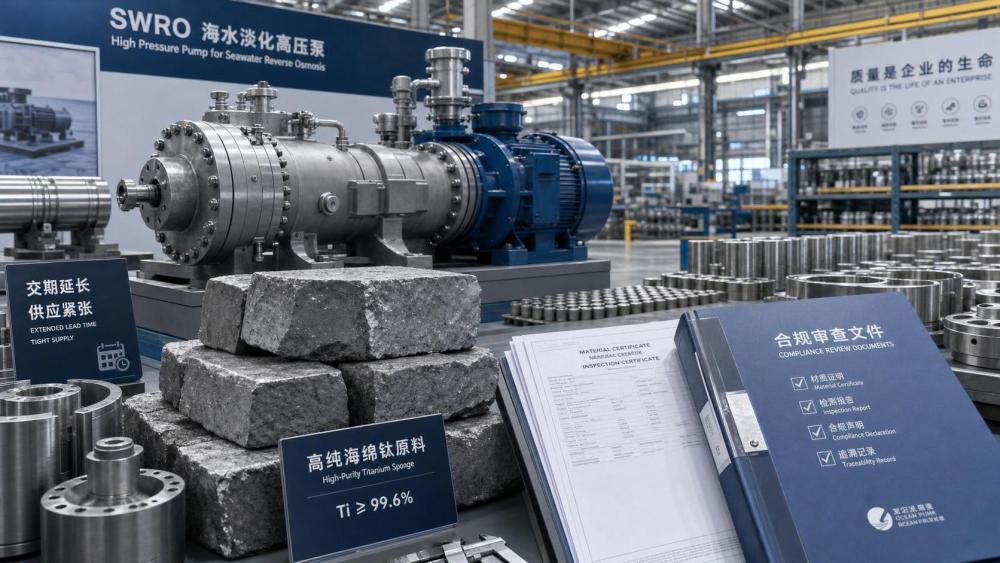
The same source summary indicates that lead times for SWRO high-pressure pumps have broadly extended to 32-36 weeks. It also states that water treatment EPC contractors in Europe and the United States are beginning to assess alternative material options.
Where the pressure is likely to be felt first
Specification-sensitive purchasing is becoming more exposed
From an industry perspective, raw material buyers and procurement teams are likely to feel the impact first where titanium grades, forging inputs, and project specifications are tightly linked. The immediate pressure point is not only price, but whether approved material lists, purchase timing, and supplier commitments remain workable when upstream allocation shifts. What deserves closer attention is whether procurement documents, mill certificates, and material traceability packages remain aligned with project requirements if sourcing routes change.
Pump manufacturers may face tighter delivery and document control demands
For manufacturers of SWRO high-pressure pumps and related forged components, the reported 32-36 week lead time range suggests greater pressure on production scheduling, contract delivery promises, and customer communication. Analysis shows that this may also increase scrutiny on technical documentation, material substitution procedures, and conformity records where a buyer asks whether an alternate material can be considered without affecting specified service conditions or approval status.
EPC contractors and project buyers may need to revisit bid and execution assumptions
For EPC contractors, owners, and project procurement teams, the issue may extend beyond component cost. Observably, when core materials tighten, tender assumptions on delivery windows, approved vendor lists, and specification compliance can become less stable. In practical terms, companies may need to pay closer attention to bid-stage wording, clarification records, and any contractual treatment of equivalent materials, revised lead times, or supplier-origin documentation.
Trade and supply-chain service providers may see higher execution risk
Direct trading companies, logistics coordinators, and supply-chain service providers may also be affected if shipment timing, order sequencing, or material booking becomes less predictable. It is more appropriate to understand this as an execution-risk issue rather than a confirmed trade-rule change: where materials are scarce and delivery periods extend, document consistency, quality traceability, and handover timing can become more sensitive across export and after-sales workflows.
What companies should monitor now
Material qualification and substitution boundaries
Analysis shows that one immediate task is to review how titanium material requirements are written into technical specifications, bids, and purchase orders. Where customers or EPC contractors are assessing alternative materials, companies should closely track whether any substitute proposal would trigger additional approval steps, revised testing expectations, or fresh documentation needs. The current information does not confirm any settled execution standard, so this remains an area to monitor rather than a concluded rule change.
Lead-time language in contracts and tenders
With SWRO high-pressure pump lead times reported at 32-36 weeks, companies should pay closer attention to delivery clauses, promised shipment windows, and extension mechanisms in active and upcoming contracts. Observably, this is especially relevant where a supplier's commercial commitment was originally built around shorter procurement cycles for titanium-related inputs.
Supplier credentials, traceability, and supporting records
What deserves closer attention is whether a shift in sourcing or forging allocation leads buyers to request more complete supporting records, such as material certificates, inspection files, traceability references, and technical conformity documents. Even without a newly announced regulation in the source material, tighter supply conditions often increase reliance on documented proof that supplied material still matches the approved specification path.
Signals from customer-side specification reviews
The report that EPC contractors are starting to evaluate alternative materials should be watched carefully as a market execution signal. Analysis shows that this may later appear in revised tender files, clarification requests, or updated technical bid alignment requirements. At this stage, however, the source material only confirms that such evaluations have started; it does not confirm that replacement materials have been approved or widely adopted.
How this development should be read at this stage
Observably, this news is less about a formally published policy and more about a rule-sensitive market signal. The core significance lies in the way a raw-material squeeze can migrate into compliance-heavy parts of industrial delivery: approved materials, qualification pathways, buyer acceptance, and contract execution. It is more appropriate to understand this as an early execution signal that may influence procurement and technical review behavior, rather than as proof that a new regulatory framework has already been implemented.
From an industry perspective, continued attention should focus on whether this supply pressure begins to alter certification expectations, tender wording, approved material practices, or customer-side review thresholds. Those changes, if they emerge, would matter more operationally than the price spike alone.
What the market signal means for the next phase
In summary, the reported rise in titanium sponge prices and the concurrent extension of SWRO pump lead times point to a tighter connection between upstream material availability and downstream delivery control. The immediate importance of this event lies in procurement discipline, specification management, and documentation readiness across the pump and water treatment supply chain.
Current evidence does not support a definitive conclusion about a new formal rule or fixed market outcome. It is more appropriate to read this development as a live execution signal: one that may affect sourcing choices, technical review, and delivery commitments, and that still requires close observation as market responses, tender practices, and customer requirements evolve.
Basis of this article and what still needs verification
This article is generated on the basis of the user-provided news title, event timing, and event summary. The specific official source link was not provided in the input and should therefore be verified on an ongoing basis.
For developments of this kind, commonly relevant source types may include official announcements, regulatory releases, customs or trade authority information, industry association updates, standard-setting documents, and reporting by established professional media. Further verification is still needed on any subsequent policy detail, certification interpretation, tender document revision, market feedback, and enterprise-side execution response that may emerge after the reported market movement.
Related News
 Are High-Pressure Plunger Pumps Suitable for Seawater RO Pretreatment?High-Pressure Flow ExpertAre high-pressure plunger pumps suitable for seawater RO pretreatment? Explore key risks, ideal applications, and smarter SWRO pump selection guidance.
 China-UAE Direct Sea Route Cuts Transit Time for SWRO High-Pressure Pump ExportsHigh-Pressure Flow ExpertChina-UAE direct sea route cuts SWRO high-pressure pump transit to under 24 days, improving delivery reliability for UAE, Africa, and South Asia water treatment projects.
 China Expands Cross-Border RMB and FX Cash Pooling Nationwide for MultinationalsHigh-Pressure Flow ExpertChina expands cross-border RMB and FX cash pooling nationwide, signaling smoother multi-currency settlements for multinationals. See what it means for exporters, supply chains, and payment efficiency.
 China’s Helium Export Ban Puts SWRO Pump Supply Under StrainHigh-Pressure Flow ExpertChina’s helium export ban is straining SWRO pump supply, delaying calibration, compliance, and delivery. Discover what this means for exporters and buyers.
 EU PPWR Takes Effect for SWRO Pump PackagingHigh-Pressure Flow ExpertEU PPWR takes effect for SWRO pump packaging, putting exporters, importers, and suppliers under stricter EU compliance on heavy metals and PFAS. See what changes now.
 EU PPWR Now in Force for SWRO Pump PackagingHigh-Pressure Flow ExpertEU PPWR now in force for SWRO pump packaging: learn how new heavy metal and PFAS compliance rules affect exports, customs clearance, and shipment readiness to Europe.
 EU Enforces Dual Certification for SWRO PumpsHigh-Pressure Flow ExpertEU Enforces Dual Certification for SWRO Pumps: learn how EN 16485:2026 impacts CE validity, customs clearance, and EU market access for exporters and distributors.
 What Drives Seawater Reverse Osmosis Energy Consumption in Plant Design?High-Pressure Flow ExpertSeawater reverse osmosis energy consumption in plant design depends on salinity, recovery, pumps, pretreatment, and ERDs. Learn what truly cuts power use and boosts SWRO efficiency.
 EU Rule Starts for SWRO Pump Energy CertificationHigh-Pressure Flow ExpertEU Rule Starts for SWRO Pump Energy Certification: learn how ErP testing, MEI ≥ 0.82, and digital energy label filing now affect EU imports, customs clearance, and delivery planning.
 EU Rule Takes Effect for SWRO High-Pressure PumpsHigh-Pressure Flow ExpertEU Rule Takes Effect for SWRO High-Pressure Pumps: Learn how EN 16485:2026 impacts compliance, IE4 verification, corrosion testing, and export access across EU and MENA markets.
 EU Revises EN 14895 for SWRO High-Pressure PumpsHigh-Pressure Flow ExpertEU Revises EN 14895 for SWRO High-Pressure Pumps: discover how the 2026 rule change impacts CE marking, EU market access, certification, and tender readiness for exporters.
 EN 13445-4:2026 Takes Effect for SWRO Pressure PartsHigh-Pressure Flow ExpertEN 13445-4:2026 now affects SWRO pressure parts, adding full-life-cycle traceability to CE compliance. See what exporters, suppliers, and project teams must review now.