EU Cybersecurity Annex Targets Smart Valve Positioners




On July 7, 2026, the European Commission published Annex VII, a cybersecurity technical guide tied to RED 2022/30/EU, and smart valve positioners immediately became a product category to watch. The update matters because it turns cybersecurity for these devices into a concrete import requirement for the EU market from January 2027, with direct implications for manufacturers, exporters, compliance teams, firmware developers, and buyers managing product qualification and delivery documentation.
What the new annex explicitly requires
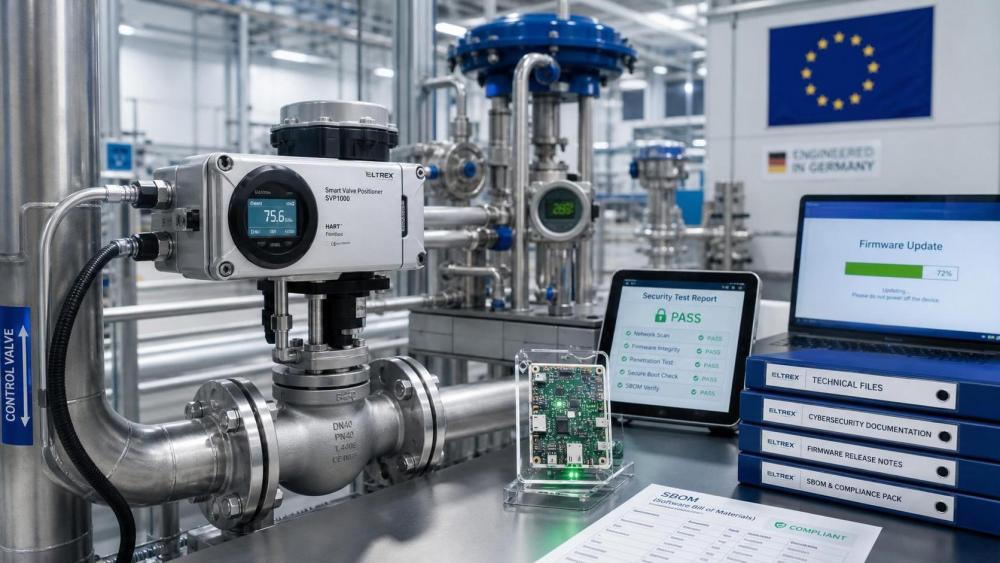
According to the information provided, Annex VII under RED 2022/30/EU was published by the European Commission on July 7, 2026. For the first time, smart valve positioners are required to pass EN IEC 63069-2:2026 testing against remote command hijacking. The same update also requires an SBOM, or software bill of materials. The rule applies to all smart positioners imported into the EU starting in January 2027. The provided information further states that Chinese manufacturers will need to upgrade both firmware security architecture and documentation delivery capabilities in parallel.
Where the impact is likely to be felt first
Export-facing manufacturers will face a tighter compliance threshold
From an industry perspective, manufacturers selling smart valve positioners into Europe are the first group likely to feel the impact. The reason is straightforward: the new annex links market access to a defined cybersecurity test requirement and to SBOM availability. In practice, the pressure will likely appear in product design review, firmware validation, technical file preparation, and shipment readiness.
EU import and channel partners may tighten supplier screening
Analysis shows that importers, distributors, and channel partners serving the EU market may need to pay closer attention to supplier qualification. If a product entering the EU from January 2027 must meet the new requirement, commercial partners are likely to focus more on whether testing evidence and software documentation can be delivered on time and in usable form. The operational effect is less about headline policy change and more about contract execution, acceptance criteria, and delivery risk.
Procurement and end-user project teams may need earlier document checks
For buyers and project teams specifying smart positioners, the likely impact is in pre-purchase review and product approval workflows. What deserves closer attention is whether compliance-related documentation is available early enough to support procurement, installation planning, or customer acceptance. Even where the device function is unchanged, the supporting technical package becomes more important.
Service and supply-chain support functions may see added coordination work
Observably, the requirement does not only concern engineering teams. Supply-chain coordinators, quality teams, and after-sales support staff may also be affected because firmware security architecture and SBOM delivery involve cross-functional handoff. The likely pressure point is not only meeting the rule itself, but aligning product, documentation, and customer communication within the same delivery cycle.
What companies should focus on now
Separate confirmed requirements from future interpretation
The confirmed points in the provided information are clear: anti-remote-command-hijacking testing under EN IEC 63069-2:2026, SBOM provision, and applicability to smart positioners imported into the EU from January 2027. Companies should distinguish these confirmed elements from any broader internal assumptions, so resources are directed at what is already explicit rather than at unverified extensions of the rule.
Review firmware security architecture against the compliance timeline
Analysis shows that the main technical concern is not only test passage, but whether the existing firmware security architecture can support that result consistently. For manufacturers, this makes timing important: engineering updates, validation, and technical documentation preparation may need to move in parallel rather than in sequence if EU-bound products are involved.
Treat SBOM delivery as a commercial and operational capability
What deserves closer attention is that SBOM is not just a documentation add-on. In business terms, it can affect quotation support, customer review cycles, tender responses, and final shipment packages. Companies serving EU customers may need to verify whether internal teams can produce, manage, and deliver this material in a format that supports actual transactions and customer communication.
Check supplier and customer communication paths early
For exporters and supply-chain teams, a practical point is whether upstream and downstream communication is ready for the new requirement. That includes clarifying which products are in scope for the EU market, which documents are expected, and how potential timing gaps in testing or documentation could affect order scheduling and fulfillment.
Why this looks bigger than a one-off documentation update
Observably, this development is more than a narrow paperwork adjustment because it combines a cybersecurity test requirement with a documentation requirement for a defined industrial device category. Analysis shows that the immediate change is short term in the sense that companies must prepare for a January 2027 import condition, but the signal itself is longer term: cybersecurity expectations for connected industrial equipment are being framed in a more operational, product-level way.
At the same time, it is more appropriate to understand this as a concrete regulatory signal rather than a fully mapped market outcome. The provided information confirms the new requirements and the implementation timing, but it does not by itself establish how quickly different suppliers, buyers, or channels will adapt. That remains an area for continued observation.
How to read this development at this stage
At this stage, the most balanced reading is that the EU update creates a defined compliance checkpoint for smart valve positioners entering the region from January 2027. For the industry, the practical meaning lies in product cybersecurity verification and the ability to deliver supporting software documentation together. It should not be overstated as a complete market reset, but it is clearly not a routine wording change either. Current attention is best placed on implementation readiness, document flow, and whether existing product architectures can support the stated requirements.
Basis of this article and points for follow-up verification
This article is based on the user-provided news title, event date, and event summary. For developments of this kind, relevant source types typically include official notices, company announcements, industry association updates, authoritative media coverage, and standards-related documents. No specific official source link was provided in the input, so the exact official reference still needs ongoing verification. Follow-up attention should remain on any later official wording, implementation clarifications, and document expectations connected to Annex VII, RED 2022/30/EU, EN IEC 63069-2:2026, and SBOM delivery for EU-bound smart valve positioners.
Related News
 How fluid control digitalization improves valve maintenance planningProcess Control ArchitectFluid control digitalization helps teams prioritize valve maintenance, reduce unplanned downtime, and improve reliability with actionable condition data.
 How smart valve positioners improve process control valve accuracyProcess Control ArchitectDiscover how smart positioners improve process control valve accuracy, reduce friction-related errors, enhance stability, and enable predictive maintenance.
 How to evaluate a valve automation supplier before placing an orderProcess Control ArchitectChoose a valve automation supplier with confidence. Learn how to assess engineering capability, compatibility, testing, lead times, and lifecycle support before ordering.
 How Does Industrial Automation Change Valve Specification Requirements?Process Control ArchitectHow does industrial automation change valve specification needs? Discover smarter sizing, diagnostics, protocols, fail-safe design, and lifecycle strategies for reliable control.
 Retrofit vs replacement automation: which option minimizes downtime?Process Control ArchitectRetrofit vs replacement automation: compare downtime, integration risk, lifecycle costs, and phased execution to protect uptime and modernize with confidence.
 When smart pneumatic control valves improve water treatment stabilityProcess Control ArchitectSmart pneumatic control valves for water treatment improve flow precision, dosing consistency, diagnostics, and plant stability. Learn how to select the right solution.
 When predictive maintenance for process valves pays off in plant operationsProcess Control ArchitectPredictive maintenance for process valves can cut downtime, reduce energy loss, and boost reliability. Learn when it pays off in plant operations—and how to justify the investment.
 Revised EN 14382:2026 Adds EMC Immunity Test for Smart Valve Positioners in EU ExportsProcess Control ArchitectEN 14382:2026 now mandates EMC immunity testing for Smart Valve Positioners, reshaping EU export compliance for valve OEMs and integrators. Learn what changed and how to prepare.
 FDA Tightens Import Rules for Smart Valve PositionersProcess Control ArchitectSmart valve positioners now face stricter FDA import rules. Learn how IEC 61508 SIL2 or UL 61508 documentation affects U.S. clearance, suppliers, and compliance planning.
 EN 14382:2026 Raises EU Entry Bar for Smart PositionersProcess Control ArchitectEN 14382:2026 raises the EU entry bar for Smart Valve Positioners with a 150 ms step response cap and IEC 62443-4-2 cybersecurity checks. Learn what exporters, buyers, and compliance teams must do before Nov 1, 2026.
 High-Precision Stainless Steel Control Valves for Corrosive Process LinesProcess Control ArchitectHigh-precision control valves stainless steel solutions improve corrosion resistance, flow stability, and safety in demanding process lines. Discover how to reduce downtime and boost control accuracy.
 How a Valve Performance Consultant Improves Uptime and Control AccuracyProcess Control ArchitectValve performance consultant insights to improve uptime, control accuracy, and energy efficiency. Learn how targeted diagnostics solve hidden valve issues across process systems.